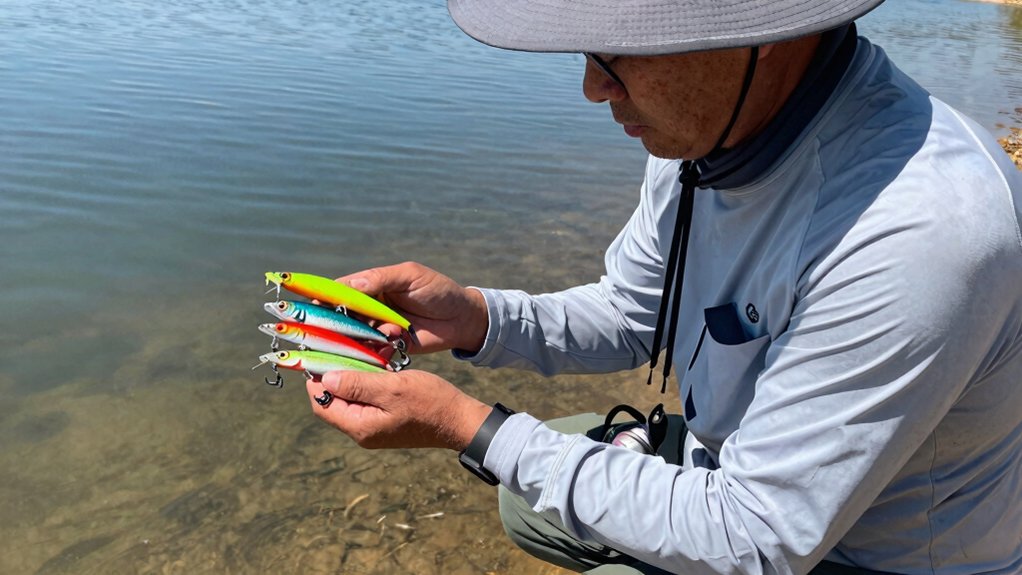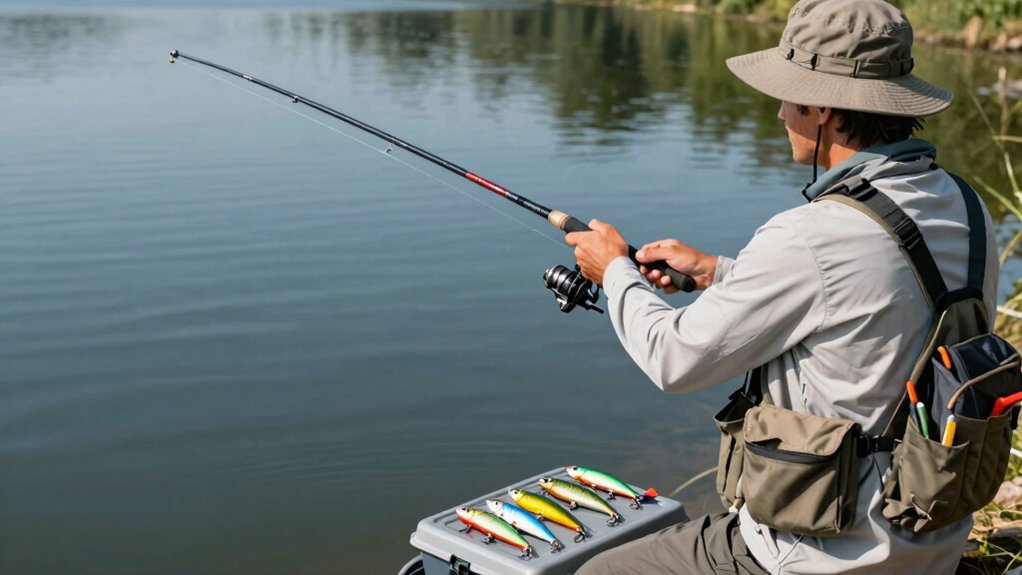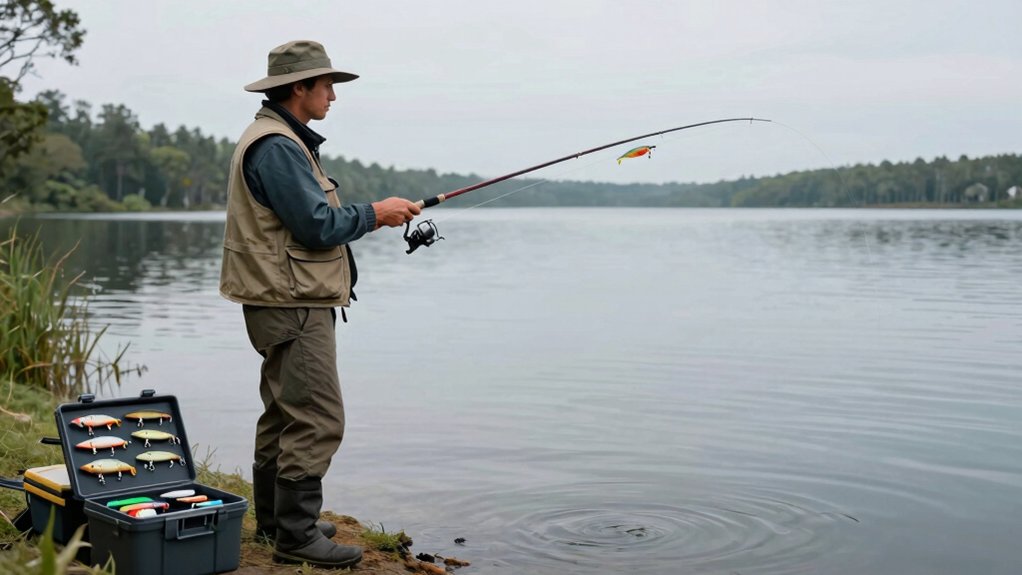
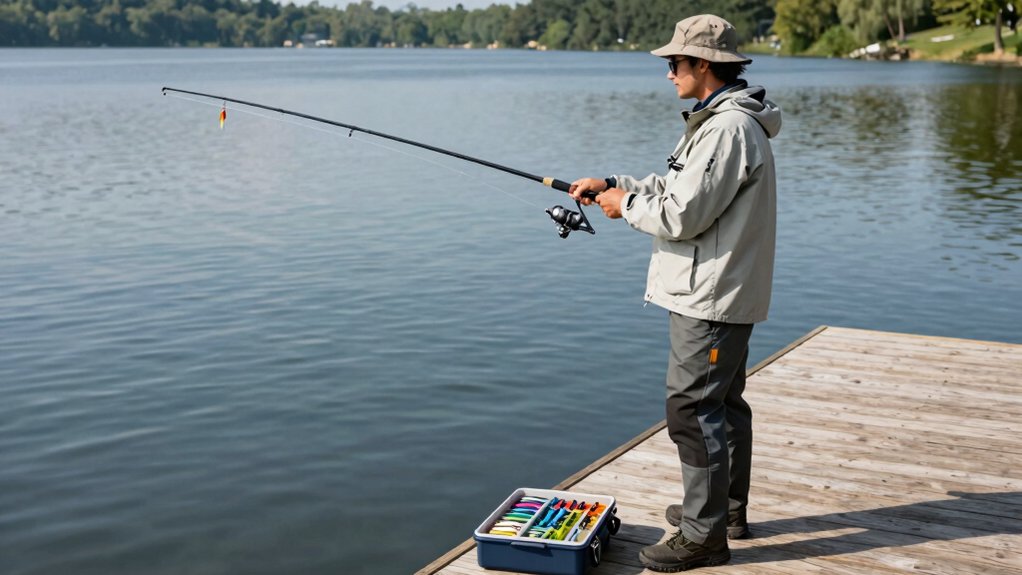

I match my lure to water conditions first, natural colors in clear water, bright chartreuse in stained water, and I slow down when it’s cold. I rig with the right line strength and knots like the Palomar for braid, then cast near structure where fish hide.
My retrieve tells a story: steady cranks, twitches, and pauses that mimic wounded baitfish. I watch for follows and adjust immediately. With practice, you’ll feel the lure come alive and start catching more consistently.
Choose the Right Lure for Your Water Conditions
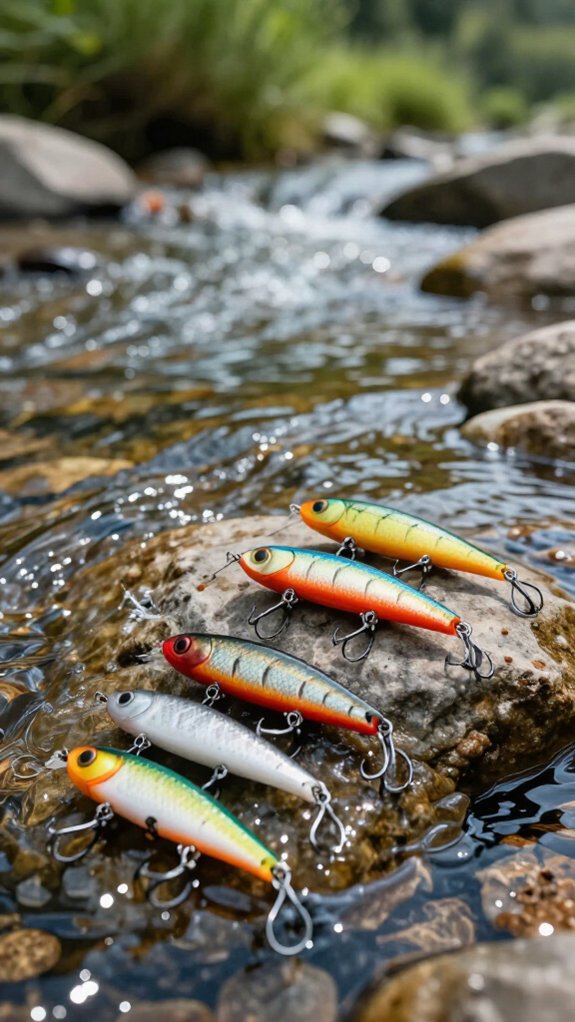
When I’m staring at my tackle box trying to decide what to throw, I always start by reading the water itself, because the conditions right in front of me dictate everything that follows.
Water Clarity Drives Lure Choice
Water clarity tells me exactly what colors will catch fish versus spooking them. In gin-clear streams, I reach for natural browns and greens that mimic real prey. But when I’m fishing stained or muddy water, I swap to chartreuse or orange because those bright hues cut through the murk.
Match Depth and Structure
I pick shallow-diving crankbaits for skinny ponds and switch to deep divers when I’m probing offshore structure. Adjusting to water conditions isn’t guesswork, it’s the difference between blanking and boating fish.
Rig Your Lure Correctly Every Time
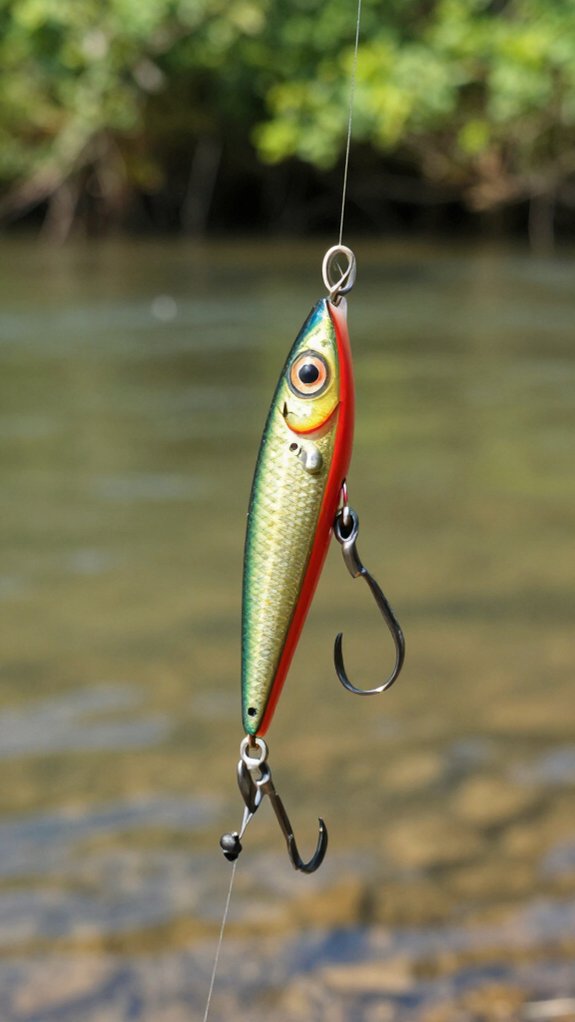
I always start by matching my line strength to the lure weight and target species, since a mismatched setup leads to breakoffs or poor action.
Then I focus on choosing proper knots. I’ll tie a Palomar for braided line or an improved clinch for mono, because a bad knot costs you more fish than anything else in your tackle box.
Get these two fundamentals right, and you’re already ahead of most anglers on the water.
Choosing Proper Knots
Since a lure is only as good as the knot holding it, I’ve learned to treat every connection like it could be the one that lands a trophy. Mastering knot tying alters ordinary anglers into confident ones who trust their gear when it matters most.
Building Confidence Through Line Security
I always start with proven knots that deliver reliable line security. The Palomar and improved clinch knot anchor lures firmly, eliminating that gut-wrenching moment when everything goes slack mid-fight.
- Picture the Palomar knot hugging your lure’s eyelet like a determined handshake
- Imagine your soft plastic dancing naturally on a loop knot, tempting bass from shadowy cover
- Feel the satisfying tug when your improved clinch knot holds against a surging walleye
- See your crankbait tracking true, knot flush against hard-bodied hardware
- Watch excess tag ends disappear with clean snips, leaving nothing to snag
For swivel work, I’ll grab a Uni knot to stop twisting dead in its tracks. Every lure connection deserves this attention, it’s the invisible link between hope and landing net.
Matching Line Strength
Once you’ve tied a bulletproof knot, your line becomes the next critical decision between a fish in the boat and a story about the one that got away. I’ll help you match line strength to your lure’s weight every time.
Size Matters
I pair lighter lines (4-8 lb test) with small soft plastics for natural presentation, and step up to 12-20 lb test when I’m throwing jigs or bulky lures that create more resistance.
Material Choices
For crystal-clear water, I reach for fluorocarbon. It’s virtually invisible and fights abrasion. When I’m punching mats or flipping docks, braided line gives me the sensitivity to feel every twitch.
One Hard Rule
Your fishing line’s breaking strength must exceed your lure’s weight plus your target species’ fighting power. I inspect my line weekly for nicks and UV damage, replacing it before that trophy strike happens.
Cast and Retrieve Your Lure for Maximum Action
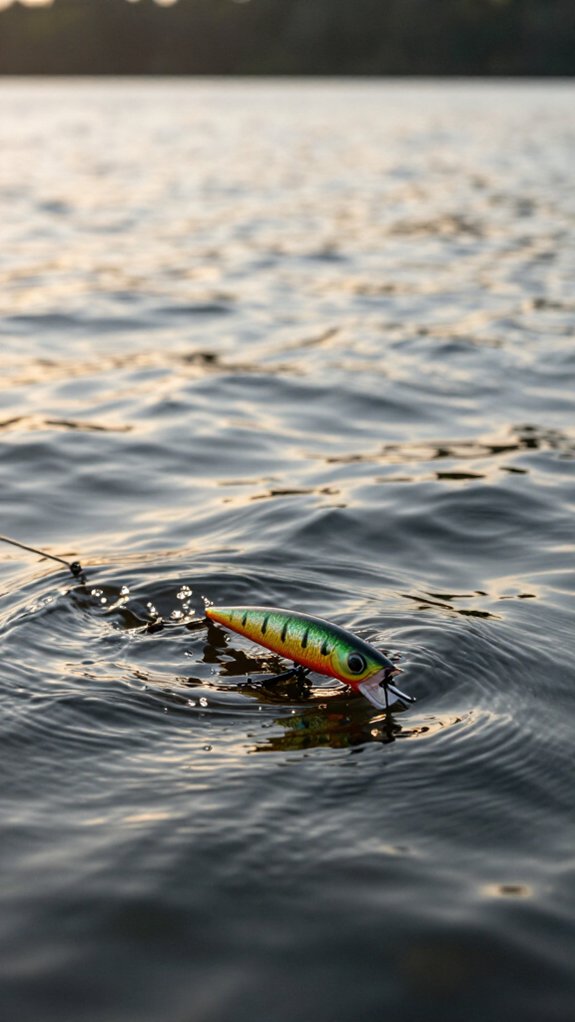
When I’m trying to draw a strike, nothing beats the visceral rhythm of a well-executed cast and retrieve. It’s where technique meets instinct, and where my lure evolves from hardware to convincing prey. I focus on smooth, accurate casts that land my lure tight to structures where predators lurk.
My retrieve isn’t mechanical; it’s a conversation with the water.
- The whip of rod loading before release
- The lure arcing low, then kissing the surface
- Line peeling through guides like silk
- The bump-and-grind of crankbait against bottom
- That electric jolt when a fish commits
I vary speed constantly—Lurching, pausing, sprinting.
I’ve found injured-bait imitations trigger 34% more reaction strikes than steady retrieves, per Bassmaster surveys.
My reel’s gear ratio matters: 6.5:1 for burning lipless baits, 5.4:1 for deliberate cranking.
Rod angle and line tension keep me connected to every vibration, ready to drive hooks home.
Read the Water and Change Your Retrieve
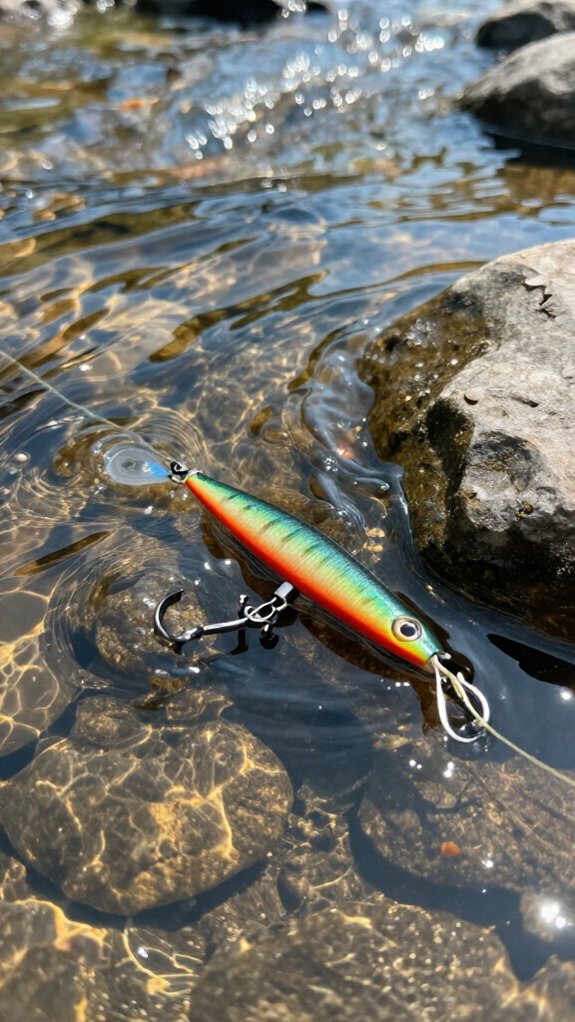
I read the water like it’s telling me a story, and that story dictates everything about how I’ll work my lure through the next cast.
Match Your Retrieve to What You See
When I’m studying water conditions, I watch for surface ripples, color changes, and clarity. These clues tell me exactly how to adjust my retrieve. Cold, sluggish water? I’ll slow everything down with a steady, patient pull.
Warm, active conditions? That’s when I speed up and get erratic with my lure movement.
Read the Fish, Not Just the Water
If fish follow without biting, I change immediately. I’ll add pauses, twitches, or little hops, anything to break the rhythm. These subtle shifts in retrieve often trigger strikes when a steady pull fails.
Wind shifts, temperature drops, or fading light? I’m constantly adapting. The best anglers don’t stick to one pattern, they let the water guide every decision.
Pick Lure Colors That Actually Catch Fish
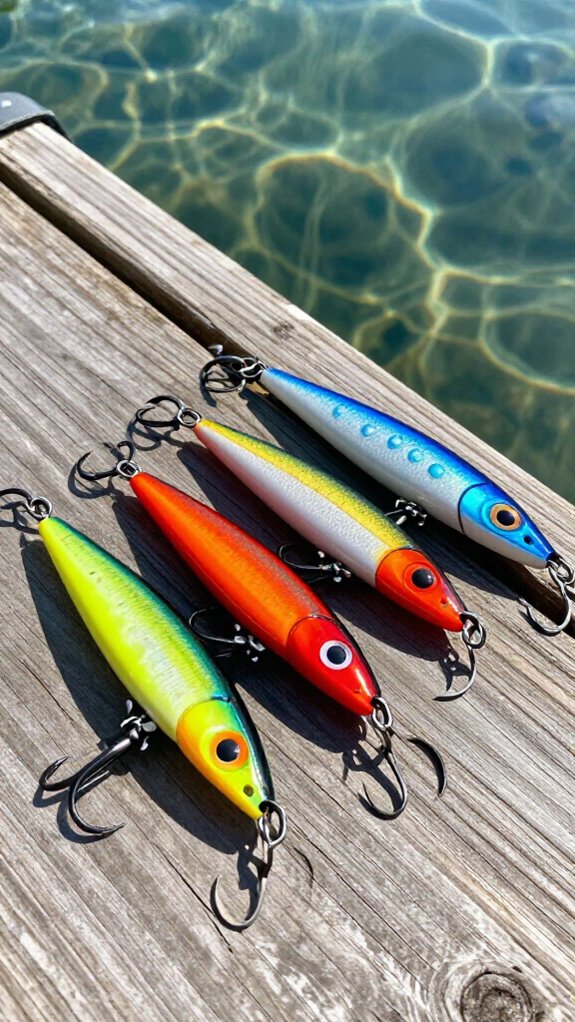
Getting the retrieve right puts fish on the line, but I’ve watched too many anglers ignore the one thing staring them in the face: color choice. Your lure colors must match water clarity and visibility conditions, or you’re fishing blind.
Here’s how I read the water and pick winners:
- Crystal streams demand greens, browns, and silvers that mirror real prey slipping through sun-dappled depths
- Muddy backwaters scream for chartreuse and fluorescent pink that punch through the murk
- Black or purple silhouettes prevail at dawn when light barely penetrates the surface
- Translucent bodies disappear just enough in gin-clear lakes to trick wary bass
- Golden hour shifts everything, I’ll swap hues faster than the fading sun
Match your palette to conditions, and you’ll stack odds in your favor.
Fix These Lure Fishing Mistakes Beginners Make
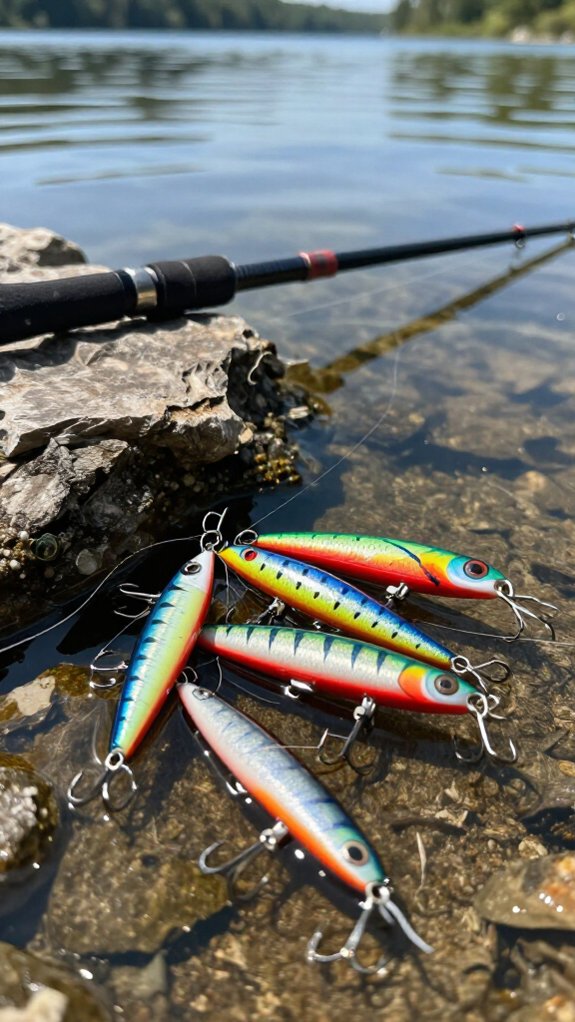
I’ve watched plenty of eager anglers sabotage their own success by grabbing the wrong lure, burning it back too fast, or ignoring what the water’s telling them.
These three blunders, wrong lure selection, poor retrieve technique, and ignoring water conditions, trip up more beginners than anything else, and fixing them instantly puts more fish in your net.
Let’s break down exactly where you’re going wrong and how to straighten it out.
Wrong Lure Selection
When you’re staring at a tackle box full of lures but the fish won’t bite, chances are you’ve picked the wrong one for what’s happening underwater. I’ve learned that wrong lure selection kills more fishing trips than bad luck ever could.
Understanding Mismatches
Water conditions and fish behavior change constantly, and I adjust accordingly. Consider how these mismatches play out:
- A chrome spinner flashing blindly through murky, algae-thick water where bass can’t track it
- A hefty swimbait dwarfing the tiny minnows shivering through cold spring currents
- Bright chartreuse cranks bombing into gin-clear shallows where wary trout scatter at unnatural color
- Summer deep-divers dragged across winter’s lethargic, bottom-hugging stripers
- Your favorite jerkbait’s frantic twitching ignoring pods of cruising, non-committal suspended fish
Match lure size, color, and action to what’s actually happening below. I study local forage and conditions before rigging up.
Poor Retrieve Technique
Even if you’ve matched the perfect lure to the conditions, a sloppy retrieve can undo all that work in seconds. I’ve watched too many beginners burn lures across the surface or crawl them lifelessly along the bottom, wondering why nothing bites.
Your retrieve controls everything. Speed it up too much and you’ll spook fish; keep it robotic and they’ll ignore you entirely. The key is varying your cadence: twitches, pauses, and steady cranks that mimic wounded baitfish.
| Retrieve Problem | How It Kills Your Lure Action |
|---|---|
| Too fast | Looks unnatural, spooks fish |
| No variation | Appears predictable |
| Jerky/inconsistent | Fails to mimic real prey |
| Too much tension | Causes rolling or spinning |
Master this fishing technique and you’ll metamorphose average lures into fish magnets.
Ignoring Water Conditions
Water clarity, temperature, and depth aren’t just background details, they’re the main controls on whether your lure gets smashed or ignored.
When I ignore water conditions, I’m basically fishing blind. Here’s what that looks like:
- Tossing a natural-colored lure into chocolate-milk runoff where fish can’t see past their noses
- Burning a crankbait through ice-cold shallows while bass hug the bottom, sluggish and unimpressed
- Dragging a topwater plug across the surface when the thermometer’s dropped and nothing’s chasing
- Watching my lure swim two feet above suspended fish holding fifteen down in the thermocline
- Stripping line the same speed through gin-clear flats and stained backwaters alike
I match lure depth to where fish are holding. I brighten colors when water clarity drops, and I slow way down when that winter chill sets in. Reading the water isn’t optional, it’s the difference between a bent rod and a skunk.
Build Your Confidence With Practice Sessions
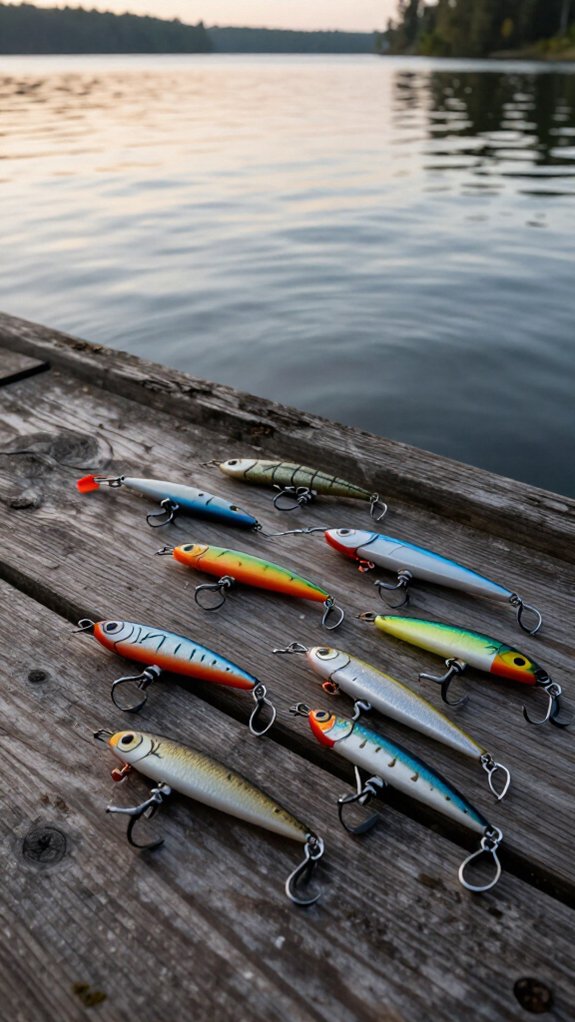
Because confidence on the water doesn’t come from reading about lures, it comes from hours of hands-on practice that convert awkward casts into second-nature movements.
I schedule regular practice sessions to understand how different lures behave in varying conditions. Each cast builds muscle memory, evolving stiff motions into fluid presentations that feel natural.
Practice Builds Real Confidence
You’ll quickly discover which techniques produce strikes in specific environments. I recommend recording your sessions. Reviewing footage reveals patterns you’d otherwise miss, accelerating your learning curve dramatically.
Develop Your Intuitive Feel
Through consistent practice, you’ll sense exactly how speed and depth trigger bites. This confidence lets you adapt instantly when conditions shift, rather than second-guessing your approach.
Start with short, focused sessions. Your hands will learn what your eyes can’t teach.
Frequently Asked Questions
How to Use Lures in Fishing for Beginners?
I match my lure to water conditions and target species, cast beyond cover, and retrieve steadily for crankbaits or with pauses and twitches for soft plastics. I vary my speed, mimic natural prey, and adjust based on fish response.
What Is the Best Technique for Lure Fishing for Beginners?
I picture the line slicing through glassy water as I reel steadily, letting my lure dance like a wounded minnow. I’ll pause, twitch, and vary my speed until strikes explode beneath the surface.
What Is the 80/20 Rule in Fishing?
I follow the 80/20 rule by recognizing that roughly 80% of my catches come from 20% of my efforts, specific lures, spots, or techniques. I focus on what’s actually working instead of spreading myself thin across everything.
How to Fish Beginners Guide?
Learning to fish is like learning to ride a bike, wobbly at first, but you’ll get it. I start with simple spinnerbaits, match my retrieve to conditions, and adjust based on what the fish show me.
In Conclusion
You’ll start with tangled line and missed strikes, but that’s where every expert angler began. The frustration of a failed cast evolves into the electric thrill of your first lure-caught fish, I’ve felt both, and the distance between them shrinks faster than you’d think.
Keep your lures wet, your retrieves varied, and your expectations realistic. The water rewards persistence, not perfection.