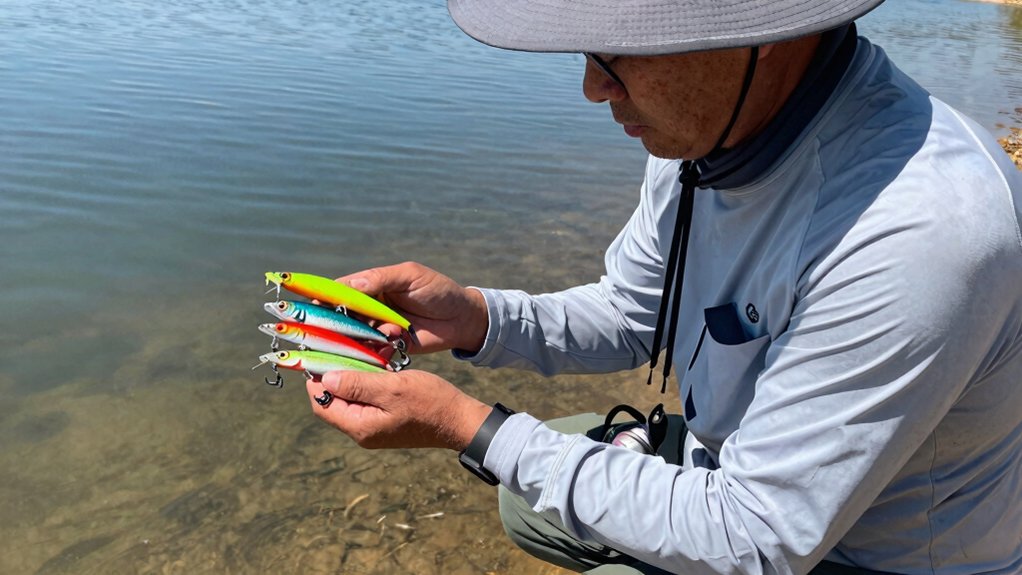
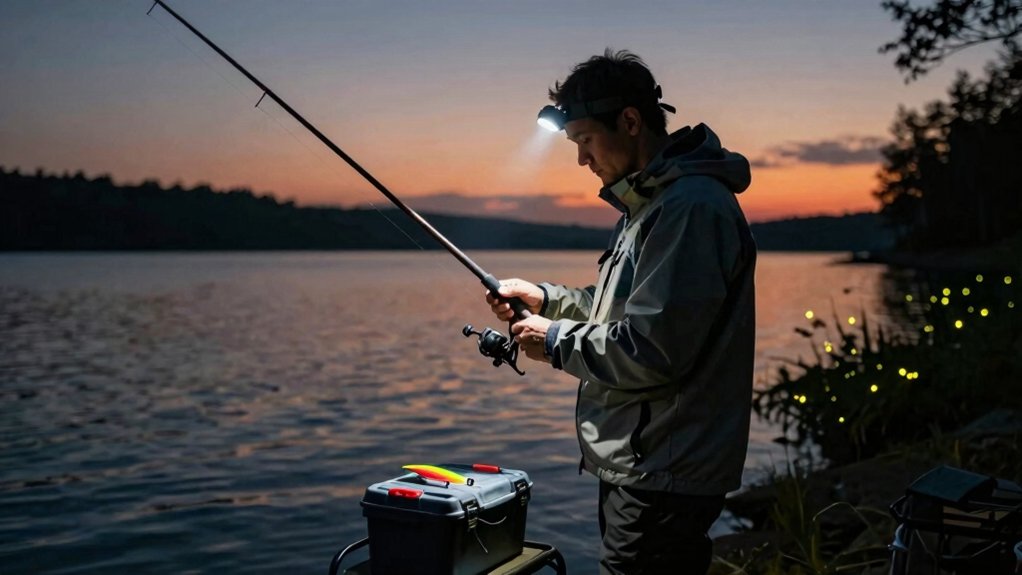

I rely on vibration, sound, and silhouette to make lures irresistible to bass when darkness turns the water ink-black and their vision shuts down. I start with black jigs and craws for maximum contrast, add rattling chatterbaits or Colorado-bladed spinnerbaits to trigger their lateral line system, and slow-roll paddle-tail swimbaits just above bottom.
I spool 20-30 lb high-vis braid on a medium-heavy rod with a sensitive tip so I can feel every thump and pressure change through my line. I keep retrieves steady with deliberate pauses, vary speeds to mimic injured prey, and stay glued to structure like rocks and timber where bass hunt by vibration alone.
When bites slow, I switch lure types every 15 minutes and sharpen my focus on line feel, because at night, my hands become my eyes. There’s more to uncover about turning those subtle taps into solid hooksets.
5 Night Fishing Lures That Outperform Everything Else (And How to Rig Them)
When the sun drops below the horizon, I reach for lures that don’t rely on a fish’s eyes alone, because at night, it’s all about vibration, sound, and silhouette.
My Top 5 Night Fishing Lures
I rig black jigs and craws first; their dark profiles slice through murky water like shadows. For covering water, I tie on rattling baits—chatterbaits and crankbaits that thump hard against a bass’s lateral line. Large Colorado spinnerbaits come next, their heavy blades pulsing with each turn of the handle.
Paddle tail swimbaits displace serious water, and I slow-roll them just above bottom structure. Finally, I work surface lures with deliberate pops, those explosive strikes still make my heart jump.
Low-Light Tactics That Work
Lure rigging matters: I upsize hooks, use heavier line, and keep retrieves slower than daytime. These low-light tactics turn missed opportunities into solid hooksets.
Why These Lures Work: The Science of Bass Hunting in Darkness
I want you to understand exactly why your lure selection matters once the sun goes down, because bass don’t shut down, they simply switch senses. Your lure’s vibration triggers their lateral line system, which becomes their primary hunting tool in darkness.
Dark colors create sharp silhouettes against the night sky that bass can actually see. When you combine these elements, you’re speaking directly to how bass locate prey when they can’t rely on sight alone.
Lateral Line Sensitivity
Since bass can’t rely on their eyes after sunset, they’ve evolved an extraordinary backup system that makes night fishing far more predictable than you’d expect.
The Lateral Line: Nature’s Night Vision
I’m talking about the lateral line, a row of sensory cells running along each side of the fish. This sensory system detects water displacement and vibrations that eyes simply can’t see.
In low-light conditions, your lure’s movement creates pressure waves. Bass pick these up instantly, tracking your offering without ever seeing it.
Research from the University of Illinois confirms that bass lateral line sensitivity increases dramatically as visibility drops.
That’s why vibrating lures predominate after dark. They generate rhythmic pulses that scream prey movement through the water column.
When I switch to blade baits or chatterbaits at night, I’m not guessing, I’m speaking directly to their most trusted hunting tool.
Vibration Detection Advantage
Although bass lose their eyesight after dark, they don’t lose their ability to hunt. You’re just speaking the wrong language if you’re throwing silent lures.
Why Vibration Changes Everything
I’ve watched fish behavior shift dramatically when I switch to sound-producing lures after sunset. Bass rely on their lateral lines—sensory organs running their flanks—to pick up lure vibrations and pressure waves. This vibration detection becomes their primary targeting system in darkness.
Research confirms fish strike faster and harder at vibrational signals than visual ones in murky or dark water. Low-light fishing demands sensory cues that cut through the blackness. Chatterbaits, rattling cranks, and spinnerbaits create disturbance patterns bass interpret as wounded prey.
You’re essentially painting with sound. Match your lure’s thump to the water conditions, and you’ll feel the difference at the end of your line.
Silhouette Contrast Visibility
When the sun drops below the horizon, water turns into ink and color becomes meaningless. What matters now is the shape you throw against that dark canvas.
Why Silhouettes Rule the Night
I reach for black and purple lures because they create killer silhouette contrast against the night sky. Bass can’t see color in low-light conditions, but they absolutely detect shape and contrast.
Research confirms predatory fish rely on visual cues, specifically outline and shadow, to hunt effectively after dark. Sharp, distinct profiles cut through the murk, giving bass the visibility they need to strike with confidence.
In night fishing, your lure’s silhouette separates dinner from debris. Bold outlines help bass distinguish prey from cover, elevating your strike probability when visibility drops to near zero.
Color Selection Rules: When Black Outperforms Everything Else
Black lures prevail my night fishing trips because they cut the sharpest silhouette against the dark sky, giving fish something they can actually track when visibility drops to near zero.
Why Black Reigns After Dark
When I’m selecting colors for night fishing success, I always reach for black first. Here’s the science behind this low-light tactic:
- Maximum contrast – Black lures absorb light instead of reflecting it, eliminating glare that spooks wary fish.
- Lateral line activation – Fish hunt using silhouette cues and vibration; black provides the boldest profile for their sensory systems.
- Murky water versatility – Unlike chartreuse or white that fade in stained conditions, black maintains consistent lure visibility.
Studies consistently show black plastics and jigs outperform brighter alternatives after sunset. My color selection rule is simple: When doubt creeps in, fish black.
Retrieve Speed and Rhythm: Controlling Your Lure’s Vibration Signature
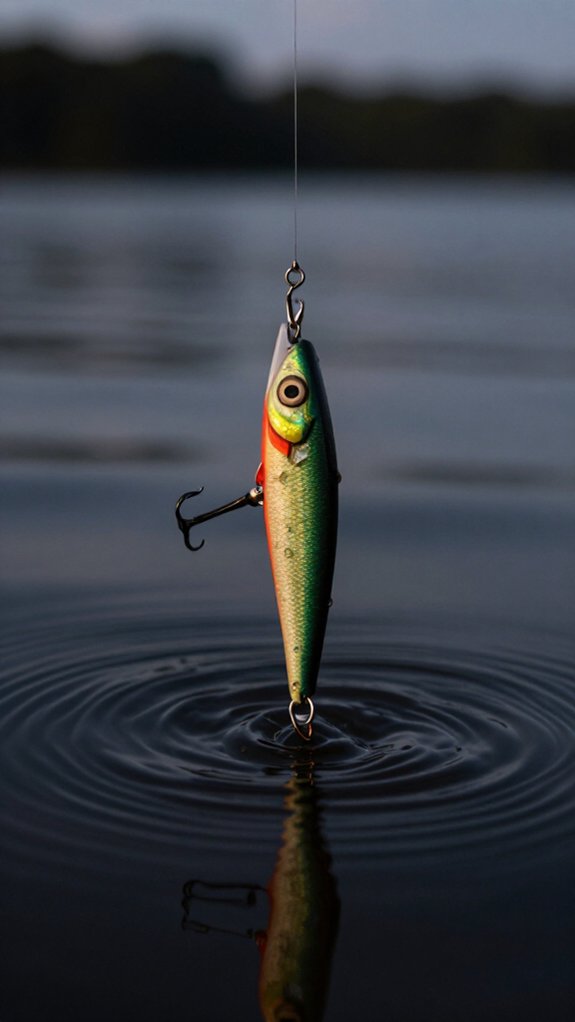
Once the sun drops below the horizon, I immediately slow my retrieve way down because fish rely almost entirely on their lateral lines to detect prey in the dark. This reduced retrieve speed creates more deliberate vibrations and water disturbance that cut through low-light conditions like a dinner bell.
I stick to a steady rhythm with purposeful pauses, let your lure suspend, and those lingering vibrations keep working in the strike zone even when you’re motionless.
| Retrieve Style | Vibration Pattern | Best For |
|---|---|---|
| Slow and steady | Consistent, strong pulses | Clear, calm nights |
| Pause-and-go | Burst then fade vibrations | Heavily pressured fish |
| Speed variations | Erratic, triggering pulses | Aggressive predators |
Keeping tight lure control means your vibrations stay focused and strong. Don’t rush, make every movement count.
Make Noise: Building Sound Patterns Bass Can’t Ignore
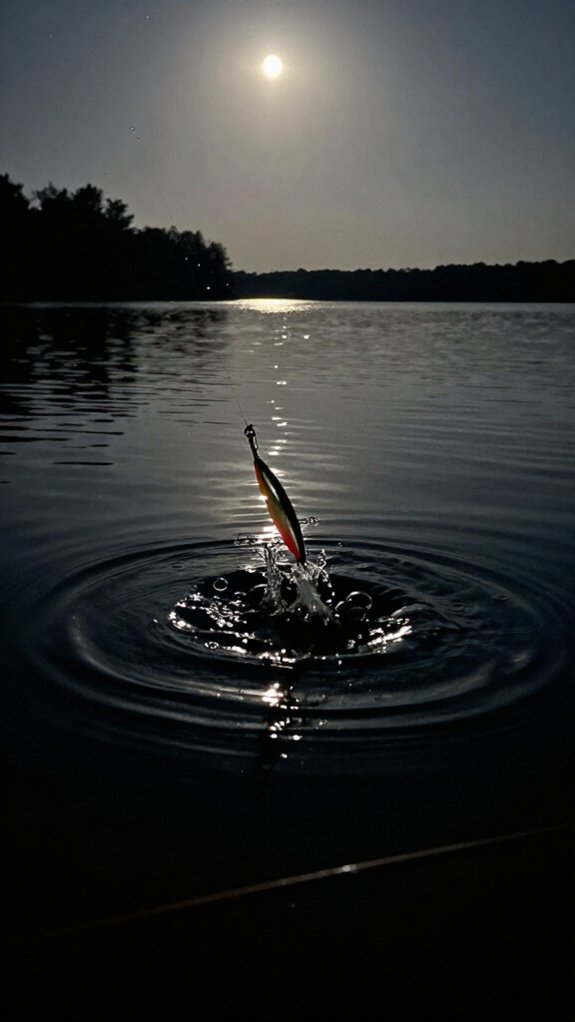
I rely on vibration and sound displacement patterns to trigger strikes when bass can’t see my lure in the dark. When I throw a chatterbait or lipless crankbait, I’m creating a “dinner bell” that bass zero in on through their lateral line and inner ear, no flashlight needed.
I’ll break down exactly how to build these irresistible sound signatures and match them to conditions so you’re not just casting blind.
Vibration Triggers Strikes
When the sun drops below the horizon and your world goes dark, a bass’s world actually opens up through its lateral line, that incredible sensory organ running along its flank that detects vibrations and pressure changes in the water.
You’re not just fishing anymore; you’re sending distress signals directly to their predatory instincts.
Sound-producing lures become your most reliable strike triggers after sunset. I always reach for these vibration-heavy options:
- Chatterbaits that generate relentless water turbulence
- Lipless crankbaits with internal rattles for amplified underwater noise
- Spinnerbaits sporting Colorado blades for thumping vibrations
- Jigs with rattle trailers for irregular acoustic signatures
- Varying retrieve speeds to create unpredictable sound patterns
That chaotic underwater noise? It mimics injured baitfish struggling helplessly.
Research from the Berkley Fish Research Center shows bass are 40% more likely to strike vibration-heavy lures in complete darkness versus visual-dependent presentations during daylight.
You’re literally letting them feel dinner before they ever see it.
Sound Displacement Patterns
Because bass rely so heavily on their lateral line after dark, I’ve learned that random noise isn’t enough. You need deliberate sound displacement patterns that tell a story underwater.
Building Rhythmic Sound Signals
I create sound signals by adding rattles to soft plastics or selecting rattle baits that produce rhythmic vibrations. These underwater vibrations travel farther in still night water, giving bass a target to track.
Varying Your Lure Retrieval
I’ve found that changing speed and cadence during lure retrieval creates distinct noise displacement bass can’t ignore. Fast, erratic pulls mimic fleeing prey; slow, steady sweeps suggest wounded baitfish.
Matching Natural Noise Patterns
Loud, consistent noise patterns trigger feeding instincts. I use Colorado-bladed spinnerbaits to amplify sound cues and time my presentations when natural ambient sounds drop.
Comprehension of these vibrations helps me produce exactly what nocturnal bass expect to hear.
The Invisible Structure: Finding Fish When You Can’t See the Bottom
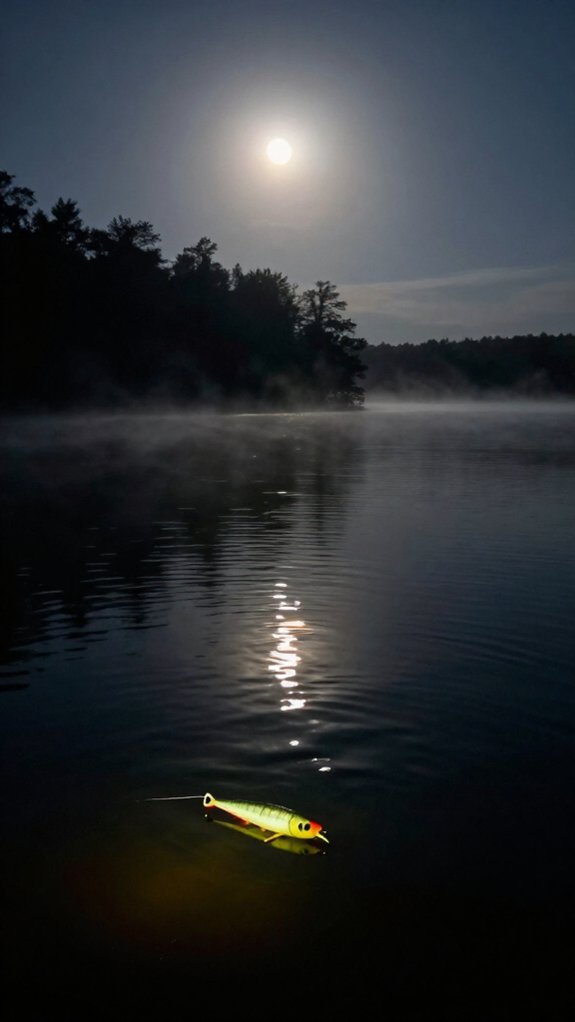
Even though darkness erases every shadow of the bottom from view, I don’t need my eyes to find where fish are holding. I just need to think like one.
In low-light conditions, fish hug structure they can feel through their lateral lines: vibrations from current breaking against rocks, timber, or bridge pilings. I rely on sonar to map what my eyes can’t see, then work my lure tight to that invisible cover.
Here’s how I locate productive zones after sunset:
- Watch for silhouettes of fallen trees or dock pilings against slightly lighter skies
- Trust sonar readings to pinpoint depth changes and submerged structure
- Target current seams where fish use their lateral lines to ambush prey
- Seek out artificial lights that concentrate baitfish and predators
- Cast parallel to structure so fish detect vibration and silhouette together
Rod, Reel, and Line Tweaks for Night Lure Fishing
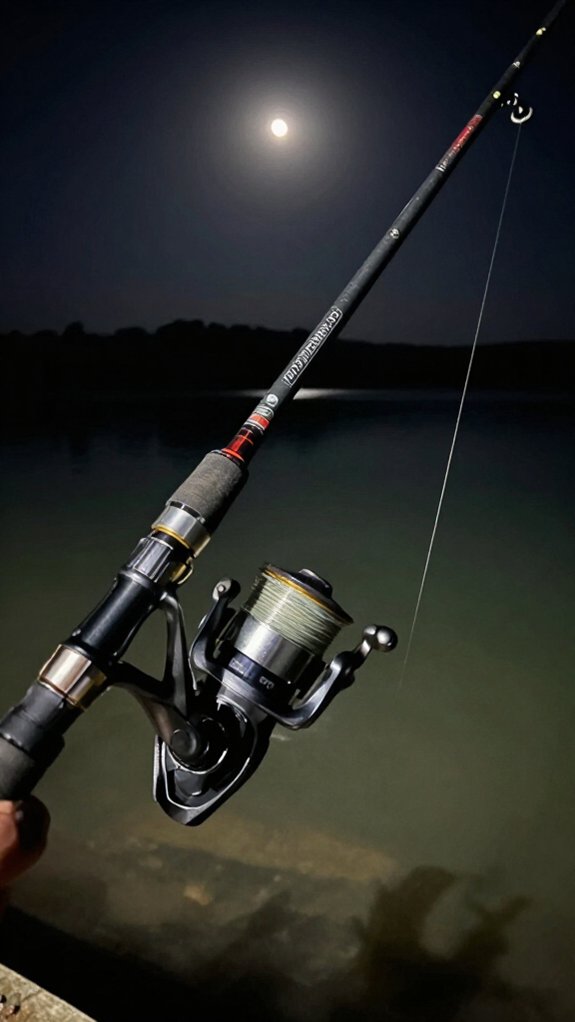
Once I’ve marked that hidden structure on my sonar and I’m ready to start casting, my gear setup becomes the difference between feeling a bite and missing it entirely.
Low-light conditions demand maximum sensitivity, and that’s why I spool up with high-visibility braided line in 20-30 lb test. You’ll feel every thump and tick instantly, even when you can’t see your lure visibility fade into the darkness.
I adjust my rod action to medium-heavy power with a sensitive tip, think of it as an extension of your fingertips.
Pair that with a 6:1 or 7:1 reel gear ratio, and you’ve got the control to slow-roll or burn lures based on fish mood.
Don’t skimp on hook selection either. Wide-gap hooks like Gamakatsu Octopus ensure tentative night strikers stick when they strike.
Match the Hatch: Identifying Nighttime Prey Species
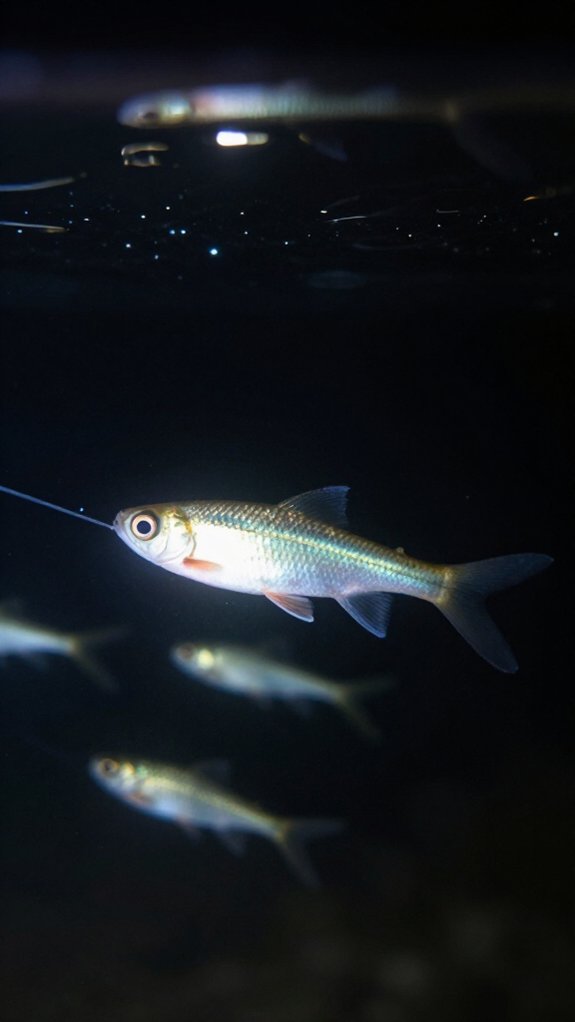
When I’m picking lures for a night session, I always start by asking what’s actually on the menu in the dark water below me.
Nighttime prey activity concentrates near illumination—dock lights, bridge lamps, or moonlit edges—where small baitfish, shrimp, and crabs seek shelter. I’ve watched bass, walleye, and flathead stack these zones, capitalizing on easy meals.
Here’s what I’ve learned about matching the hatch after dark:
- Prey size dictates my lure weight and length
- Local prey species determine my color and action selection
- Reflective scales demand flash or UV finishes on my lures
- Luminescent features in shrimp and baitfish make glow lures deadly effective
- Adjusting lure profiles to match silhouette and movement seals the deal
Moon phase, water temperature, and tide shifts alter prey behavior, so I stay flexible with my approach.
Reading the Water: Using Sound and Touch to Locate Fish

Picking the right lure is only half the battle after dark, I’ve got to find the fish first, and my eyes aren’t much help when the sun’s gone down.
Fish rely heavily on their lateral lines to detect prey through vibrations and pressure changes in low visibility. I use this to my advantage by creating disturbance that they can feel. My line feel becomes my eyes—I track every twitch and tremor to map what’s below.
Here’s what I’m monitoring:
| Sensory Cue | What It Signals | My Response |
|---|---|---|
| Steady resistance | Structure contact | Lift and pause, then continue |
| Rhythmic ticks | Water currents shifting | Adjust retrieve speed |
| Soft, irregular taps | Subtle bites | Set hook immediately |
When I notice gentle vibrations without weight, fish are nearby investigating. I slow my retrieve and stay ready. The tap-tap of a curious bass feels different than snag or current. I’ve learned that distinction through hours of night fishing.
When the Bite Dies: Quick Fixes for Slow Night Fishing
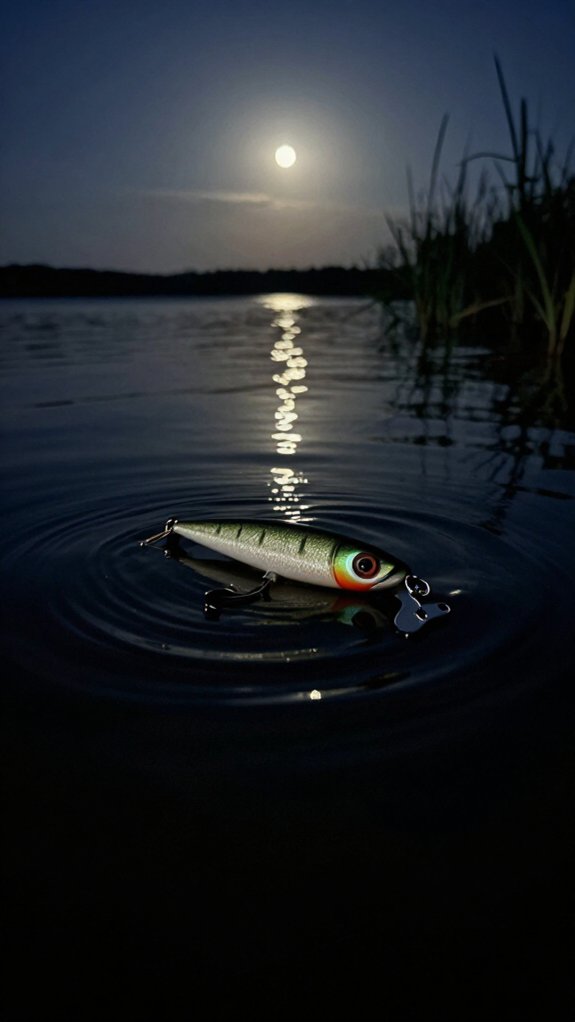
When the bite dies at night, I immediately adjust my lure action by slowing my retrieve and adding subtle pauses so fish can home in on vibrations.
Then I’ll switch bait types, trading silent plastics for rattling or glow-in-the-dark options that cut through the darkness.
I’ve found that working these changed presentations tight to docks, brush piles, or artificial lights puts me back in contact with active fish when others are packing up.
It’s a simple one-two punch of presentation and placement that turns dead stretches into productive ones.
Adjust Lure Action
Even the hottest night bite can fizzle without warning, leaving you staring at a motionless line while the fish move on to easier meals. When this happens, I adjust my lure action before giving up on a spot entirely.
Small tweaks to your retrieve often turn a dead night into a memorable one.
Here’s what I do when the bite slows:
- I throw in a sharp pause to let the lure suspend like injured prey
- I speed up my retrieve to enhance water vibration and draw fish in from farther out
- I add quick jerks and twitches to imitate erratic prey movements
- I switch to a popping or chattering motion to change the lure action entirely
- I experiment with varying retrieve depths until I find where they’re holding
These adjustments keep my lure in the strike zone longer and give sluggish fish a reason to commit.
Switch Bait Types
If I’ve tried every retrieve adjustment and the bite’s still dead, I reach for a completely different bait type before I pack up and move.
Why a Bait Change Works
Fish behavior shifts constantly during night fishing. When they ignore my artificial lures, I’ll switch bait categories entirely, trading soft plastics for vibrating crankbaits or surface lures for bottom-hugging jigs. This targets different feeding zones and triggers reaction strikes from hesitant fish.
Quick Fixes I Keep Ready
- Go natural: Live minnows or worms often save a slow night when nothing else works
- Add glow: Switching to glow lures improves visibility when dark colors fail
- Mix it up: Combining rapid bait changes with varied retrieval techniques keeps fish guessing
I’ll cycle through options every 15 minutes until something clicks.
Frequently Asked Questions
What Lure Works Best at Night?
I choose dark-colored vibrating lures, rattling crankbaits, or surface poppers when I’m night fishing. I’ll add glow or UV improvements in murky water.
I always rely on lures that create strong vibrations and water displacement since fish can’t see well in darkness.
Can You Use Lures at Night Time?
I use lures at night all the time. They work great when I pick ones that vibrate, rattle, or glow.
Fish don’t need to see them clearly, They’ll find them through sound and movement in the dark.
What Are the Best Techniques for Night Fishing?
I work the night shift with slow, steady retrieves, keeping my lure knocking on heaven’s door along the bottom. I’ll pause and twitch when they’re hesitant, letting vibrations and rattles do the talking in darkness.
Can Fish See Your Lure at Night?
I know fish can see my lure at night, but it depends on conditions. They use specialized eyes and lateral lines to detect movement, vibration, and silhouette against dim light. So I choose bright or glow lures strategically.
In Conclusion
You now know exactly which lures cut through darkness and why bass hunt them so aggressively. But here’s what keeps me coming back: that moment when vibration suddenly goes dead in your hands, then thump, something massive inhales your black spinnerbait.
The water explodes. Your heart stops. That’s not luck. That’s every tactic we covered, stacked together, finally paying off. Now rig up. The bass are waiting, and they’re already hunting in the dark.