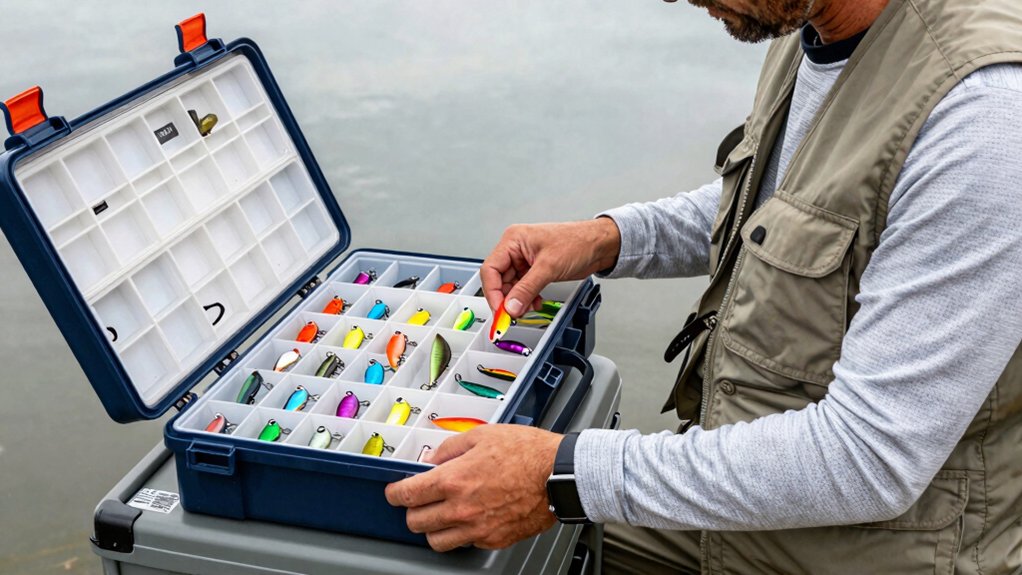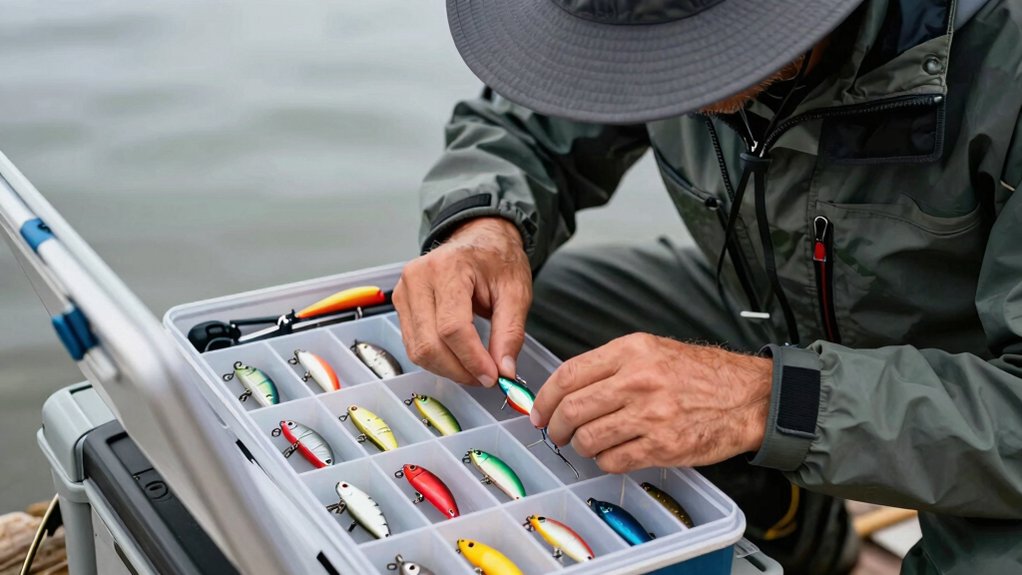
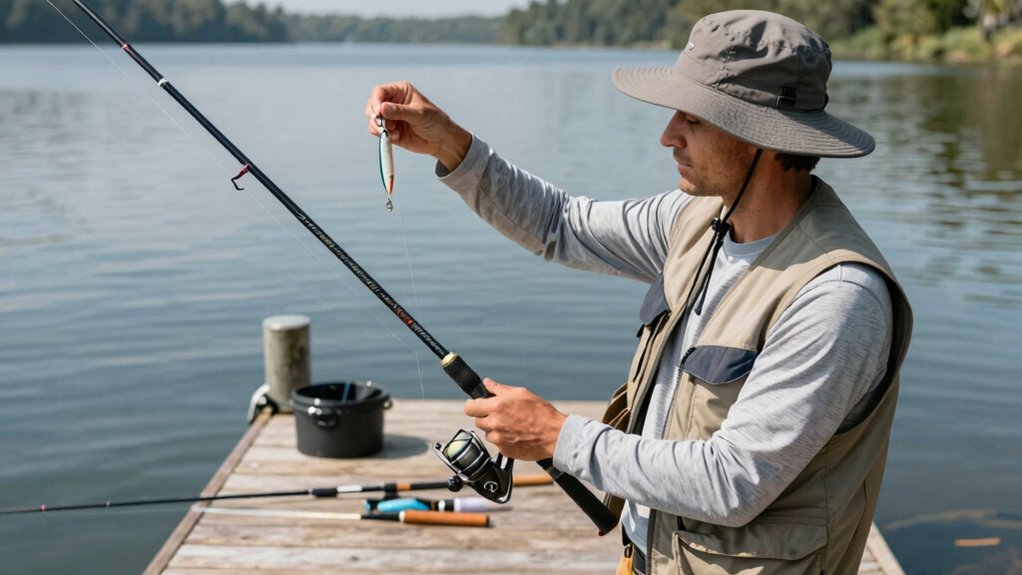

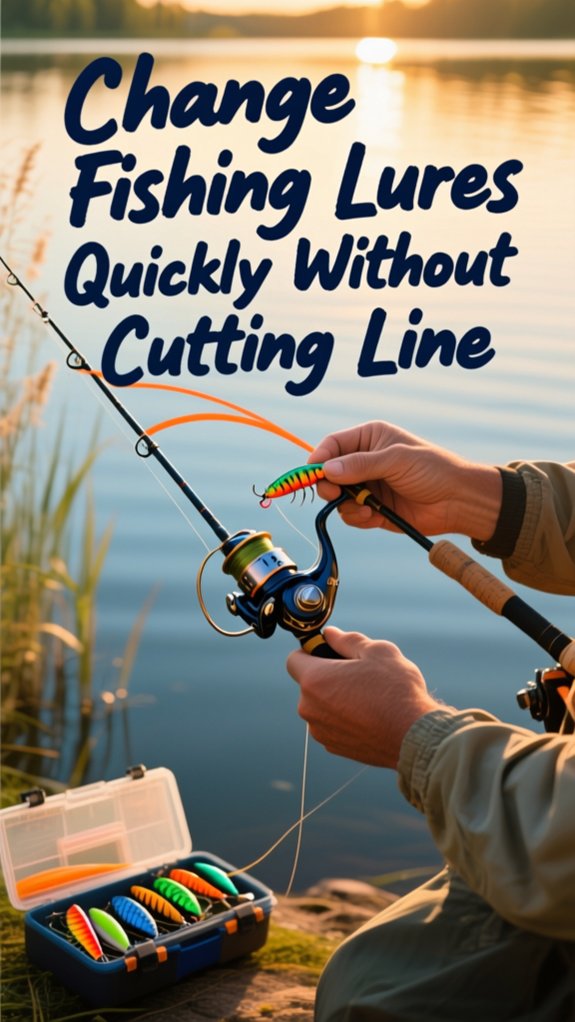
I change fishing lures in under ten seconds without cutting my line by using a quick-change snap clip tied with a Palomar knot, and with a little practice, you can too. Here’s how it works: I pinch the snap open, drop the old lure, thread the new lure’s eye through, and press until it clicks shut, then I give a quick tug to verify.
I use size 0 snaps for 3/8–5/8 oz lures and size 1 for up to 1 oz so my baits swim true. I keep pliers and line cutters within reach, and I add a rubber stop above the snap to block grass and slime from jamming things up.
For heavy cover or trophy fish, I’ll skip the snap and tie direct so I don’t lose fish to a popped clip. The real game-changer is cradling my rod in my palm for one-handed swaps when I’m bank fishing and can’t set anything down.
Stick around and I’ll show you exactly when to upgrade to tactical clips and which connectors work best for every lure type in your box.
What You’ll Need for Fast Lure Changes
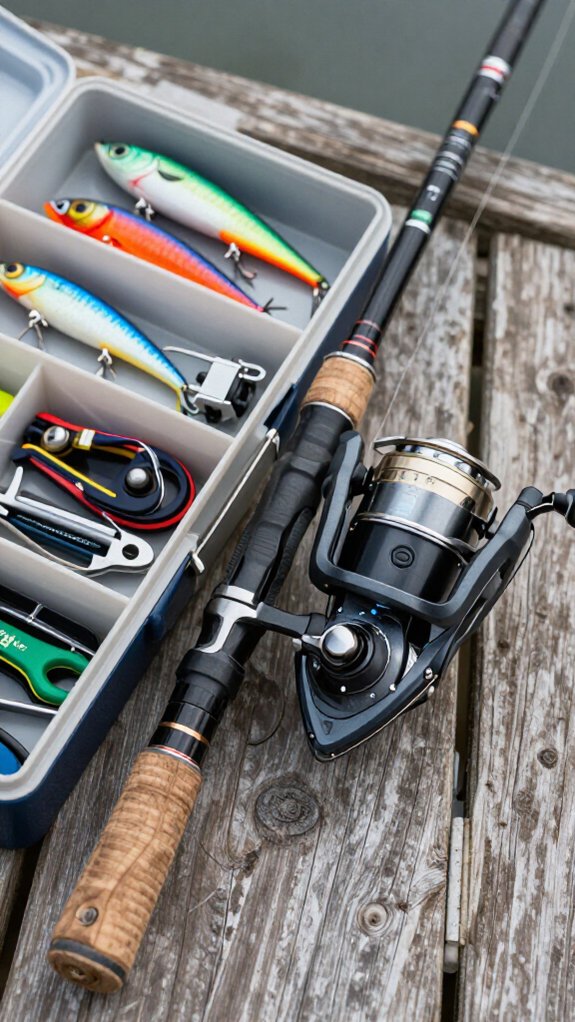
Before I hit the water, I grab a handful of quick-change clips because they’re the single best upgrade I’ve made for switching lures fast without retying knots every ten minutes.
Essential Gear Setup
I stock size 0 snaps for 3/8-5/8 oz lures and size 1 for anything up to 1 oz. Going too big kills the action; too small risks failure on a fighter.
I always tie a strong knot, either Palomar or improved clinch, to secure the snap directly to my line. Weak knots defeat the whole purpose.
Smart Additions
Rubber stops above the snap keep grass and debris from catching. I keep pliers and line cutters within arm’s reach for stubborn clips.
Change Lures in 10 Seconds: Step-by-Step
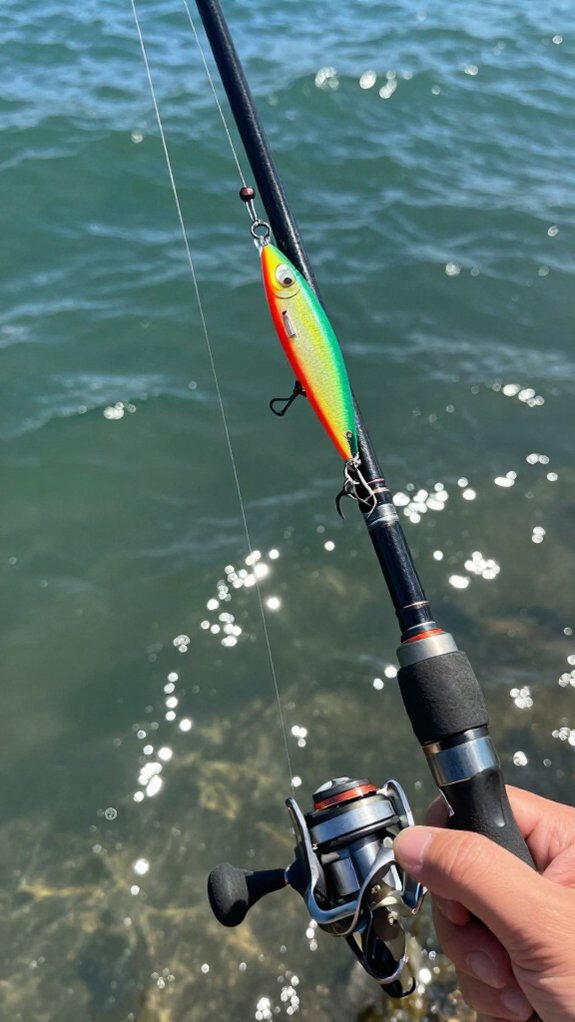
Once I’ve got my snap locked onto the line, I can swap a crankbait for a spinnerbait in about the time it takes a bass to flash past a weed bed, roughly ten seconds flat.
Here’s how I Change Lures lightning-fast:
- Pinch the snap – I press the quick-release clip with my thumb, feeling the satisfying click as it opens.
- Drop the old lure – The crankbait slides free, dangling from my rod holder.
- Clip the new one – I thread the spinnerbait’s eye through the snap, press until it snaps shut, and give a quick tug to verify.
That’s it. No retying Fishing Knots, no trimming tag end, no fumbling.
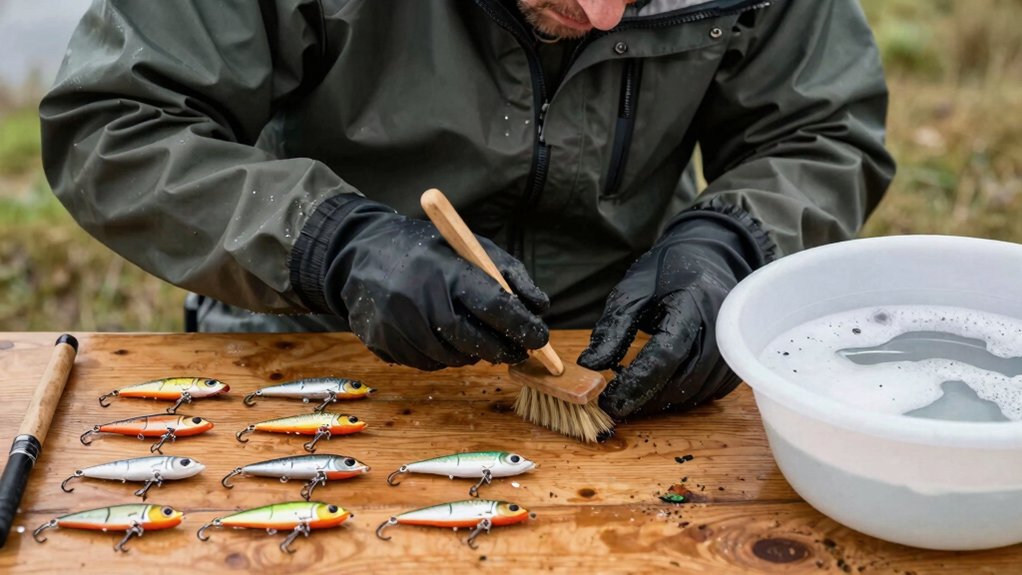
I keep my snap’s action butter-smooth with occasional rinses. A sticky clip costs precious seconds when the bite’s hot.
Secure it right, and you’ll never launch a lure into the lily pads mid-cast.
The Knot That Protects Your Line Strength
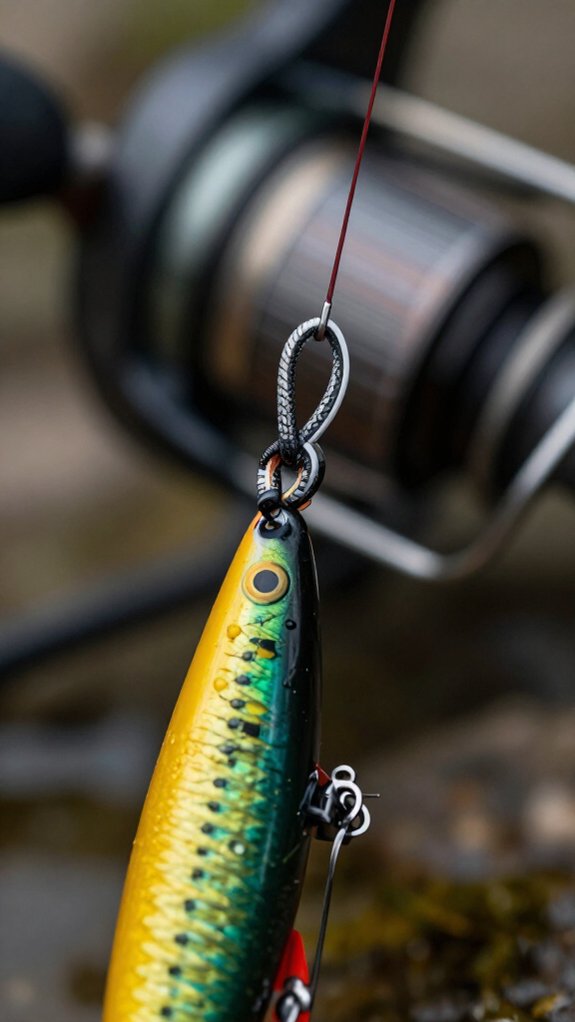
Snaps save me seconds on the water, but the real insurance policy lives in the knot I tie before that clip ever sees the line. I rely on the Palomar knot because it keeps roughly 90% of my line’s original strength intact, which means fewer heartbreaks when I’m fighting a lunker.
Here’s how I build this connection:
| Step | Action | Why It Matters |
|---|---|---|
| 1 | Double the line | Creates a secure loop |
| 2 | Pass through the eye | Positions the knot correctly |
| 3 | Tie an overhand knot | Forms the base structure |
| 4 | Wet before tightening | Reduces friction heat |
| 5 | Trim tag ends close | Prevents snag-ups |
This setup works well with everything from fluorocarbon to braid. I Always wet my knots before cinching, that little splash of saliva or water keeps the line from weakening under friction. The Palomar also shields against sharp lure edges, so my line stays strong through dozens of lure swaps.
Snap Swivel or Split Ring: Pick Your Connector
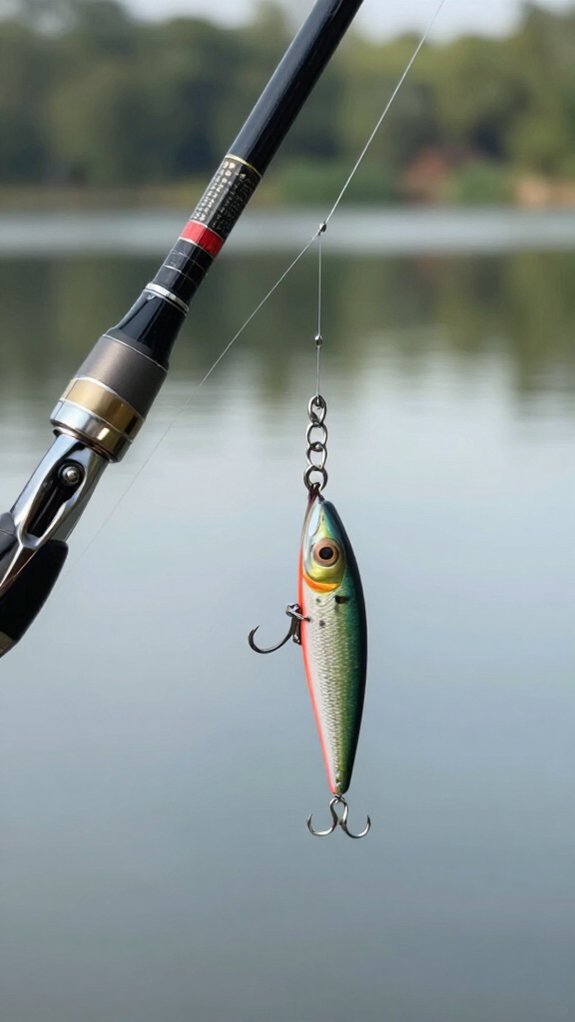
I weigh speed against security every time I rig up, and that choice starts with whether I’ll clip on a snap swivel or thread through a split ring.
Snap swivels let me swap crankbaits in seconds when the bite’s hot, but I’ll reach for a split ring when I’m throwing heavy swimbaits or punching thick mats where a failed connection means losing my $25 lure.
Matching your connector to your lure’s hook style and the cover you’re fishing isn’t just smart rigging, it’s the difference between landing fish and telling stories about the ones that got away.
Speed Versus Security
How do you decide between a quick lure swap and a connection you can trust when a trophy fish is tearing line off your reel? I weigh speed against security every time I rig up.
When Speed Wins
Snap swivels let me change lures in seconds, no fumbling, no tools. I snap on a crankbait, feel that satisfying click, and I’m casting again. But I’ll admit, I’ve watched poorly secured snaps pop open during a fight, sending my $15 jerkbait to the bottom.
When Security Matters
Split rings demand patience. I wedge them open with pliers, thread carefully, squeeze shut. It’s slower, no doubt. Yet when a 40-inch pike hits, that solid ring-to-eye connection keeps me confident.
My Approach
I match the connector to the mission: snaps for covering water fast, split rings when I’m hunting heavy fish that’ll test every weak point.
Lure Compatibility Factors
Whether I’m reaching for a snap swivel or a split ring depends entirely on what’s tied to the end of my line, because not every lure plays nice with every connector.
Matching Connector to Lure Type
I match my connector to the lure style. Snap swivels shine with crankbaits, jerkbaits, and topwater lures that already have split rings, letting me swap faster than a bass can strike.
For soft plastics and Texas rigs, I skip snaps entirely. Those need direct knots for bulletproof security.
Size Matters
I pay attention to snap sizing. Size 0 handles 3/8-5/8 ounce lures, while size 1 manages up to 1 ounce. Too big looks clunky; too small snaps under pressure.
When to Use What
- Treble hook lures: Snaps for quick changes
- Single hook plastics: Direct tie for strength
- Moving baits: Swivels prevent line twist
I pick based on action needs, not convenience alone.
Right Snap Size for Your Lure Weight
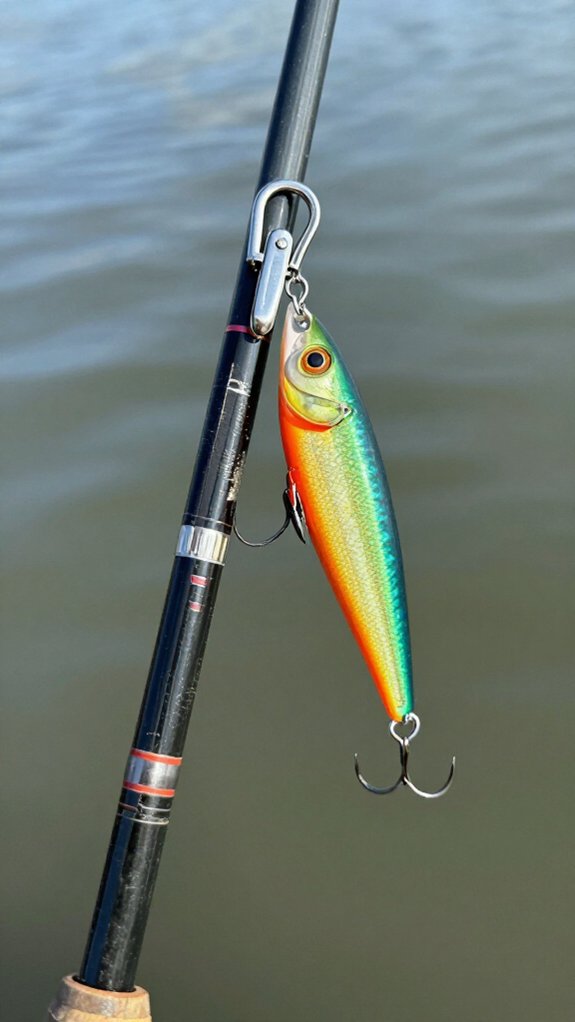
Because I’ve lost too many lures to weak snaps snapping mid-cast, I always match my snap size directly to lure weight before I hit the water.
Getting this right keeps your lure swimming true and your line intact. Here’s how I break it down:
- I grab size 0 snaps for lures between 3/8 and 5/8 ounces, they fit snug without bulking up my presentation.
- I step up to size 1 snaps when I’m throwing lures up to 1 ounce, since they handle that extra stress without failing.
- I always size up for heavier lures to maintain strength when a fish slams my bait at boat-side.
Match your snap to your lure’s weight, and you’ll cut down on the heartbreak of watching your favorite crankbait sail into the trees, or the depths.
Best Lures for Snap Connections (And What to Avoid)
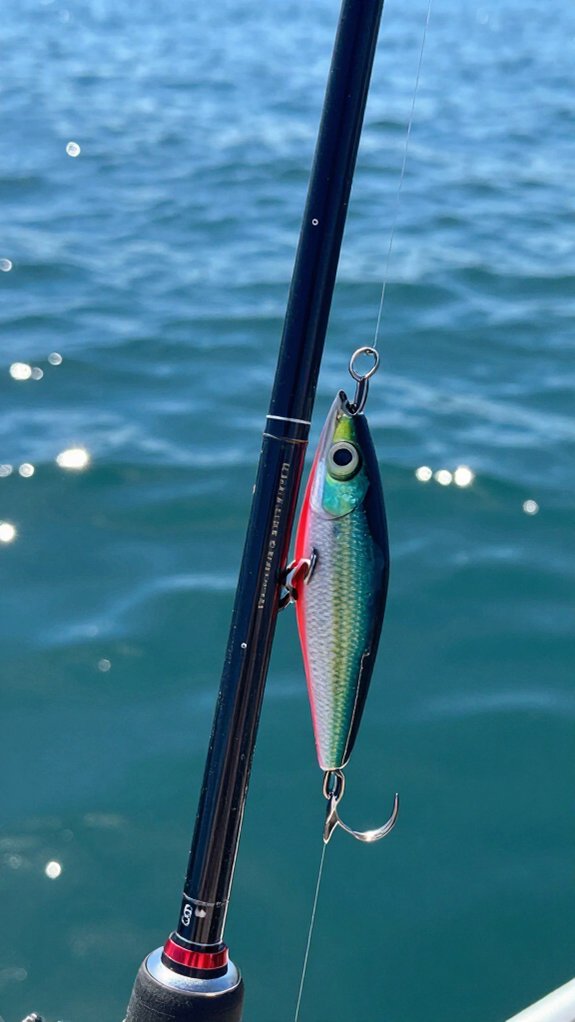
I reach for snaps when I’m throwing crankbaits, jerkbaits, or topwaters with treble hooks because they let me swap lures in seconds without retying knots every time.
You’ll want to skip snaps entirely for soft plastics, Texas rigs, or anything that needs a direct, secure knot connection to swim right.
Stick to treble-hooked hard baits and you’ll keep your line in the water longer instead of fumbling with knots at the wrong moment.
Ideal Snap Lures
When I’m looking to swap lures fast without retying knots every five minutes, I reach for snaps on my crankbaits and jerkbaits every single time. These treble-hook lures were practically built for snap connections.
My Go-To Snap Setup
- I match size 0 snaps to lures weighing 3/8 to 5/8 ounces, and size 1 snaps for anything up to 1 ounce.
- I always run snaps through the split ring on my crankbaits, that’s my golden rule for keeping action natural.
- I Skip snaps entirely on plastics, jigs, and topwater frogs; those need direct knots for solid hooksets.
One thing I’ve learned the hard way: grass loves snagging on open snaps. I’ll slide on a small rubber stop when I’m fishing thick cover. It saves me way more headaches than you’d think.
Avoid Single Hooks
Although snaps are my go-to for treble-hook lures, I’ve learned to leave them off anything with a single hook. Worms, jigs, and frogs simply don’t play well with snap connections, and here’s why.
The Hookset Problem
When I snap on a Texas-rigged worm or flipping jig, that extra hardware becomes a weak link between my rod and the fish. The snap’s movement absorbs energy I’d rather transfer directly into the hook point.
I’ve watched solid hooksets turn into heartbreaking misses because that metal loop flexed at the wrong moment.
Better Alternatives
For soft plastics, I tie direct with a Palomar or improved clinch knot. No hardware, no failure points, just clean energy from rod tip to hook bend.
The difference in solid hookups is immediately noticeable.
Save your snaps for crankbaits. Single hooks demand direct connections.
When Should You Skip the Snap and Tie Direct?
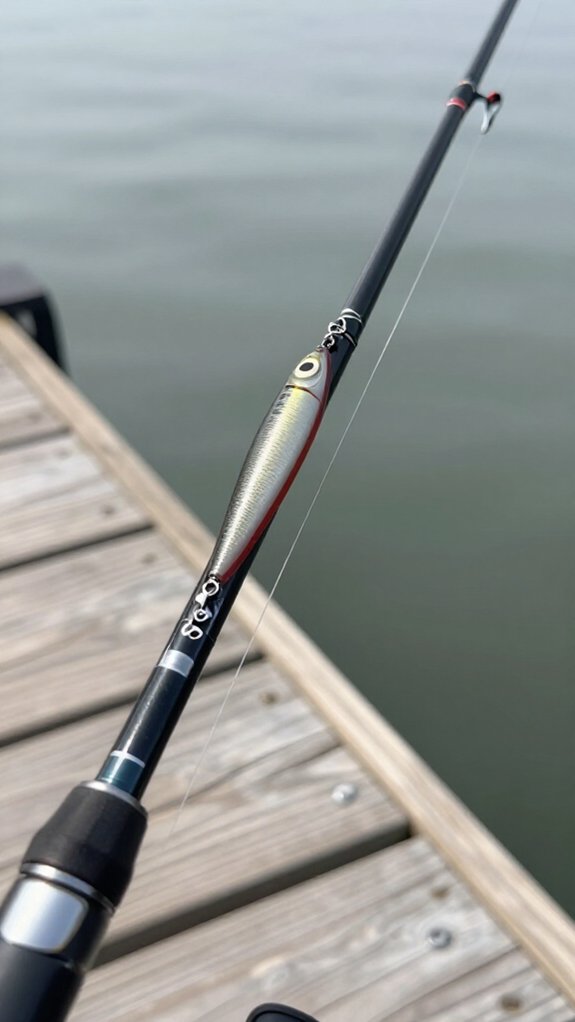
Because I want every hookset to count, I’ve learned that skipping the snap and tying direct isn’t just an option, it’s often the smarter play.
I tie direct when I’m punching plastics into thick mats or dragging Texas rigs through timber. That solid knot connection translates every twitch and bite straight to my rod tip—no energy lost to a clunky clip.
Heavy cover demands zero weak points. I’ve watched too many bass bury themselves in brush while a snap slowly straightens open. Direct tying locks my lure to the line with no failure point.
- When You’re Flipping Into Dense Vegetation Where Every Second Matters
- When You’re Throwing Soft Plastics That Need Subtle, Natural Movement
- When You’re Targeting Trophy Fish That Test Every Piece of Your Terminal Tackle
Keep Your Snap Clean: Beat Grass and Slime
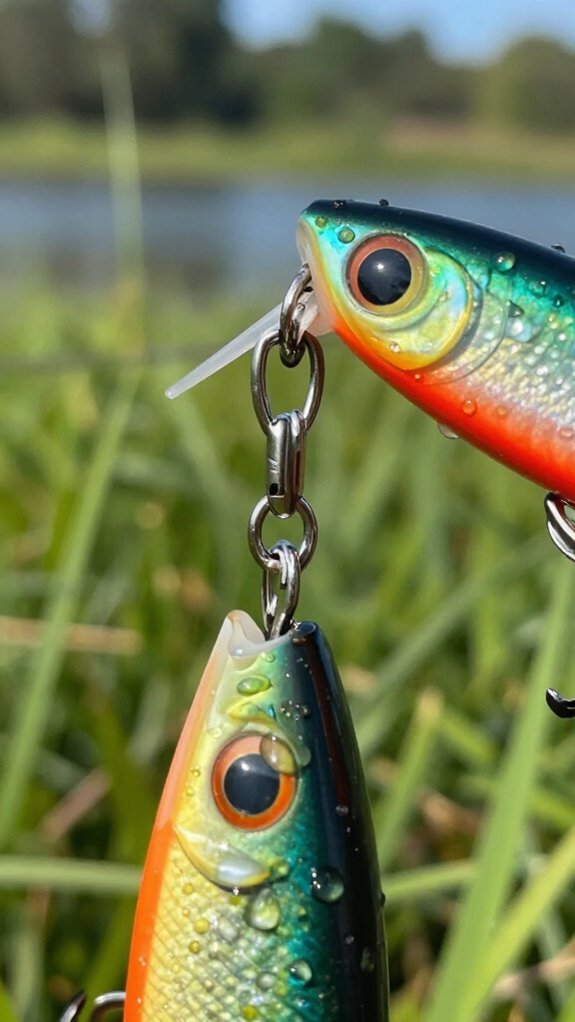
Let me break down the requirements: keeping your snap free of grass and slime ensures quick, hassle-free lure changes all day long.
Stop the Slide
I slide a rubber bobber stop above my snap to block weeds and slime from creeping down the line. It’s a simple fix that saves constant re-tying.
Pick the Right Snap
I switched to Fastach snaps with their streamlined wire design, and I immediately noticed fewer tangles with grass and algae compared to bulkier traditional snaps. Choosing the correct size matters too, oversized snaps collect more debris.
Clean as You Go
I inspect my snap every few casts during heavy vegetation. A quick wipe removes buildup before it jams the connection.
These habits keep my lure swaps smooth and prevent losing tackle to a gunked-up snap.
Tactical Clips: When to Upgrade for Big Fish
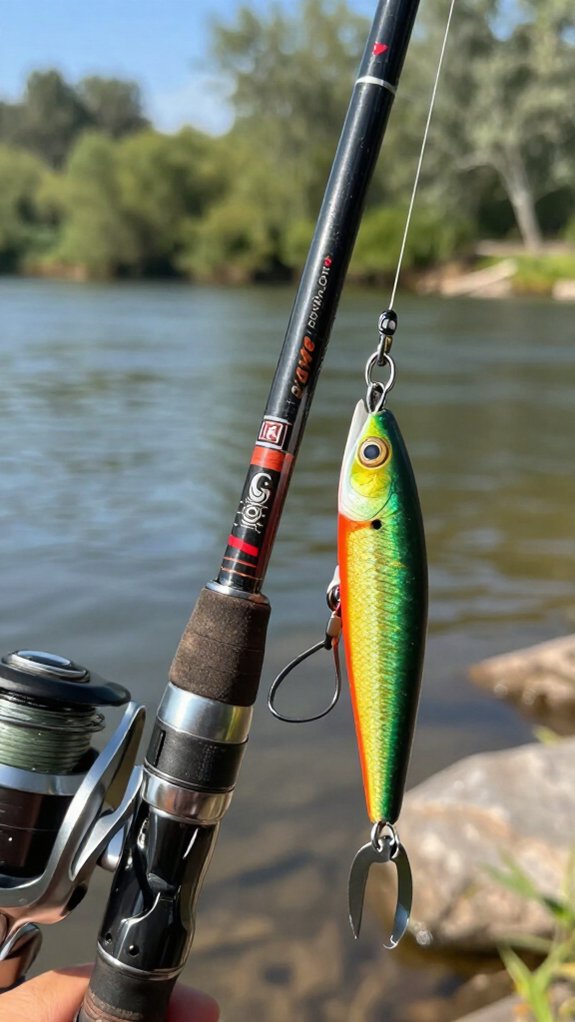
I upgrade to tactical clips the moment I’m targeting fish heavy enough to straighten standard hardware or snap a weak snap clean off.
You know that heart-dropping pop when a big redfish or trophy bass hits and your lure simply vanishes? That’s my signal I waited too long.
Choosing the right clip strength before I need it keeps my lure swimming true and my line connected when it matters most.
Strength for Giants
When I’m staring down a lunker bass or a bull redfish that’s about to inhale my lure, the last thing I want is my clip to be the weak link in my setup. That’s why I’ve upgraded to tactical power clips built specifically for giants.
- Heavy-duty construction withstands brutal runs and violent headshakes without deformation
- Secure locking mechanisms maintain integrity under crushing strain from trophy fish
- Proper load ratings match breaking strength to my line and drag settings
I’ve watched too many big fish disappear when flimsy clips straighten out mid-fight. With robust tactical clips rated for serious abuse, I hook that monster with complete confidence, knowing my hardware won’t fail when everything’s on the line.
Clip Selection Timing
Knowing exactly when to swap my standard clips for tactical upgrades has saved me more trophy fish than I can count.
I upgrade right before heading to deep water or heavy cover, those brutal strike zones where standard clips fail under pressure. When I start losing lures or missing hookups, that’s my signal to switch immediately.
Prime Upgrade Moments
- Pre-season prep: Tactical clips enhance presentation during peak feeding windows when giants actively hunt.
- Structure-heavy water: Thick vegetation and timber demand secure connections that won’t pop mid-fight.
- Target confirmation: Spotting larger fish on the graph means instant clip rotation before the cast.
The quick-change advantage lets me adapt without cutting line, keeping me in the strike zone longer.
One-Handed Lure Changes From the Bank
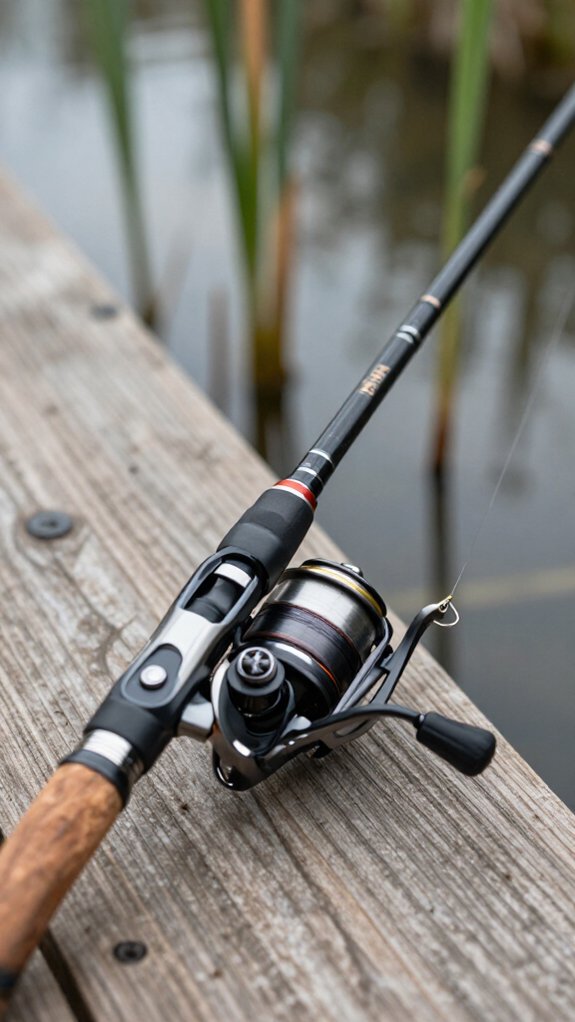
Why struggle with both hands when you’re pressed against overhanging branches or perched on a rocky shoreline? I’ve mastered one-handed lure changes by snapping a quick-release clip onto my line before I even reach the water.
Here’s how I keep it smooth when space gets tight:
- I secure my line to the snap with a trusted knot, nothing ruins a day like watching a $12 jerkbait sail into the drink because I rushed the connection.
- I cradle the rod in my palm, pop the old lure free with my thumb, and clip on the new one without ever setting the rod down.
- I run a swivel above the snap when I’m burning spinnerbaits or cranking deep divers, since one-handed swaps can twist line into a bird’s nest if I’m not careful.
I practice the snap motion at home until my fingers know it by feel. Muscle memory beats fumbling when the bite’s hot and I’m wedged between two boulders.
Frequently Asked Questions
What Is the 80/20 Rule in Fishing?
I apply the 80/20 rule by recognizing that 80% of my catches come from just 20% of my techniques and lures. I’ve learned to focus my efforts on what’s proven effective, streamlining my tackle and maximizing my time on the water.
What Lure Attracts Bass the Most?
Crankbaits catch ’em consistently, but I’d say soft plastics swirled and twitched mimic their menu best. Shad shades, chartreuse choices, and crawfish copies tempt ’em terrifically.
I tailor my tackle to water clarity and current conditions confidently.
Should I Tie My Lure Directly to My Line?
I tie my lure directly to the line when I’m after big, aggressive fish that’ll test my gear. It’s stronger than clips, though changing lures takes longer. I use Palomar knots for reliability.
Do You Use Swivels With Lures?
I don’t always use swivels with lures, but when I’m chasing spinning baits, it’s a game changer. I clip on a snap swivel and swap lures in seconds without retying a single knot.
In Conclusion
You can change lures in seconds without ever cutting your line, just snap, clip, and cast. Picture standing knee-deep at dawn, mist rising off the water, your line singing as you switch from a topwater popper to a diving crankbait between rising trout.
That fluid rhythm keeps you in the strike zone longer, turning frustrating tangles into seamless motion. Master these quick-change tricks, and you’ll feel the difference: more casts, more confidence, more fish coming to hand.