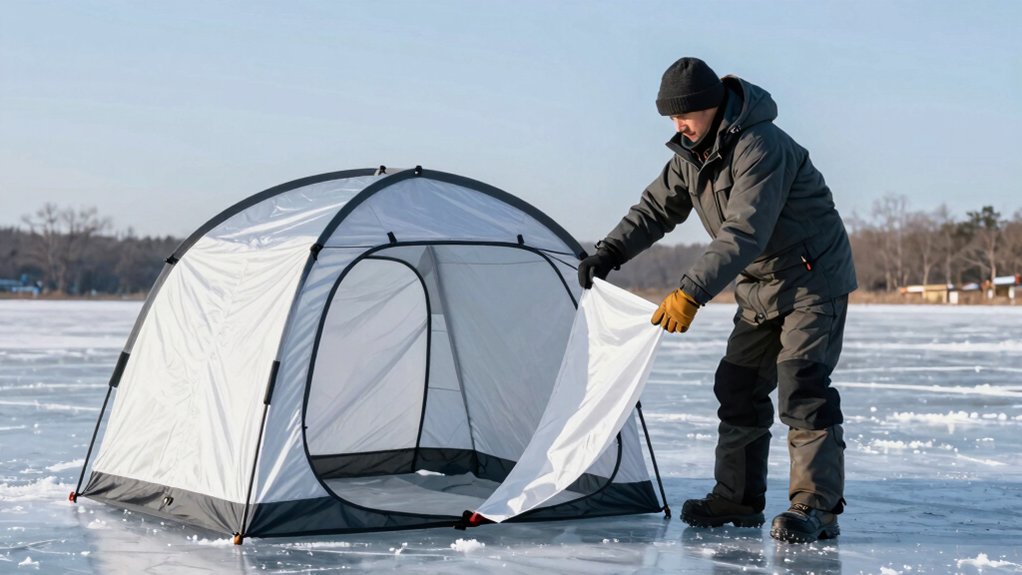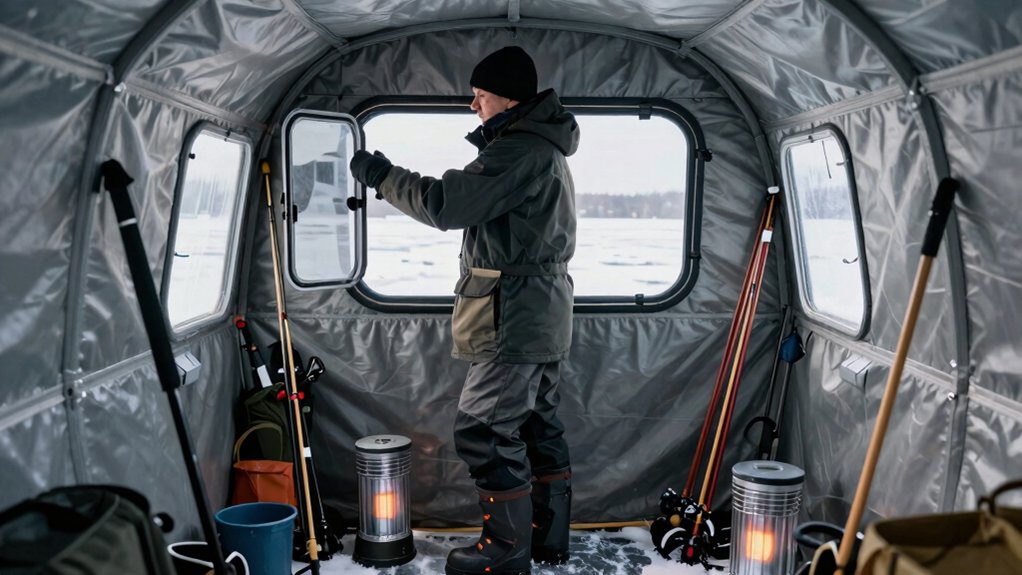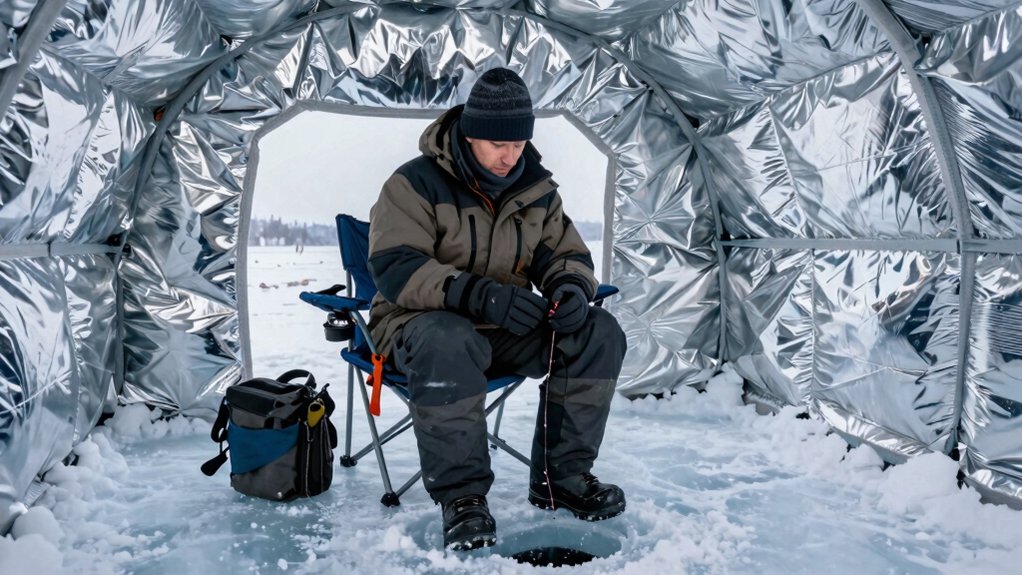
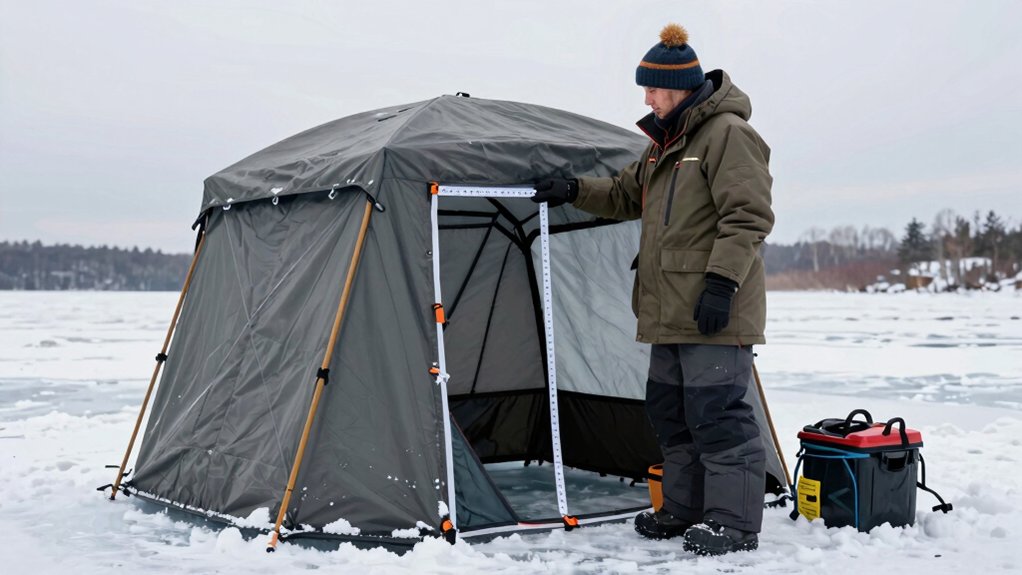

Match your shelter to your actual group size plus one extra person for comfort, since box ratings ignore gear and elbow room. I’d grab 30-40 square feet for solo trips or 20-30 square feet per person for groups, with at least 70 inches of interior height so you’re not hunched over all day.
Don’t forget to factor in how you’ll haul it, heavier shelters need sleds or ATVs, while lighter ones work for foot travel. There’s more to getting this right than just counting heads.
How Many People Will Your Ice Fishing Shelter Actually Hold?
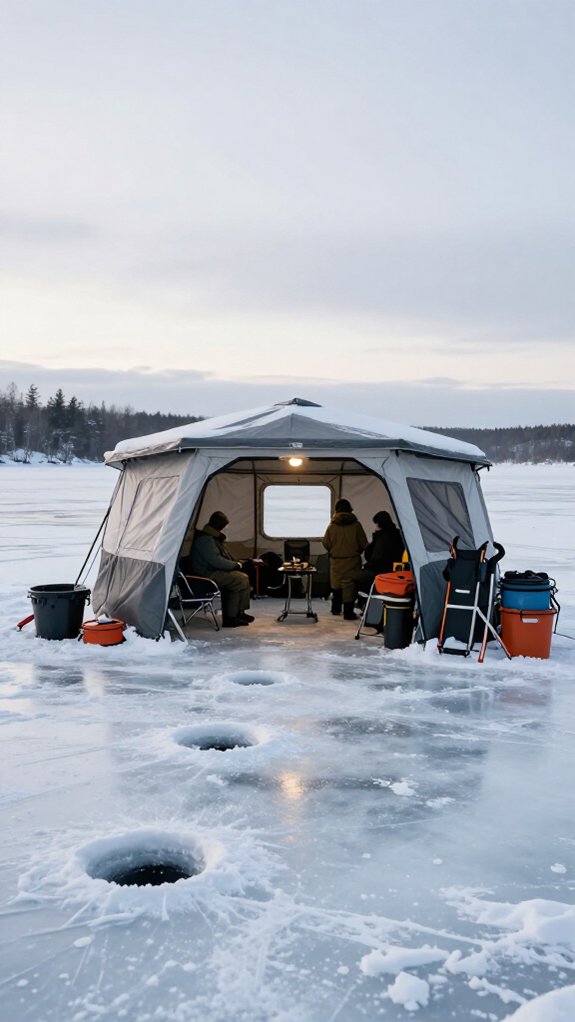
While it might seem obvious to match your shelter size to your headcount, I’ve learned the hard way that cramming four guys into a “4-person” hub leaves zero room for the gear, heaters, and elbow room that make a long day on the ice bearable.
The Real-World Capacity Rule
I always tell anglers to size up by 1-2 people beyond their actual group. A solo angler or pair thrives in a 2-4 person shelter. You’ll have space for rods, buckets, and freedom of movement without bumping elbows.
When I’m fishing with three buddies, I grab a 6-person model minimum.
Why Interior Space Matters
Fishable floor area dictates everything. More capacity means drilling multiple holes, walking around tip-ups, and stowing cots or propane heaters.
I’ve watched cramped crews tangle lines and trip over gear while I’ve got room to stretch.
The Weight Trade-Off
Bigger shelters haul heavier. That 8-person palace keeps everyone happy but demands a sled or ATV.
I balance my group’s comfort against how far I’m dragging gear across frozen lakes.
Hub or Flip-Over: Which Design Fits Your Group Size?
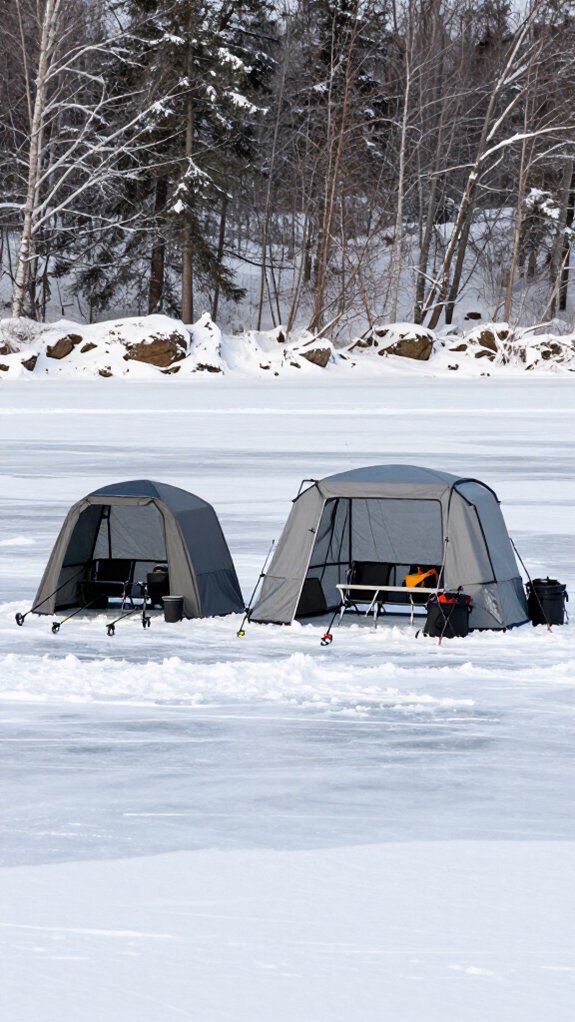
Once you’ve nailed down how much room your crew actually needs, you’ve got to decide which shelter style delivers that space without wrecking your back or burning daylight on setup.
Hub shelters stretch 120 to 200+ square feet, swallowing four or more anglers with headroom to spare. Flip-over shelters cap out around four people but trade interior space for raw speed and portability.
Here’s how each design plays out on the ice:
- Picture four buddies standing upright in a hub, rods rigged, coffee steaming, while snow piles outside.
- Imagine flipping your sled-mounted shelter in ninety seconds, hole-hopping before the bite dies.
- Feel the hub’s fiberglass poles flexing as you wrestle five minutes of setup for all-day comfort.
- Sense the flip-over’s aluminum frame biting wind, sacrificing space for setup speed when you’re solo chasing crappies.
Your group size dictates everything. Big crews need hub shelters. Small teams thrive with flip-over shelters.
Pick a Shelter Size You Can Actually Haul
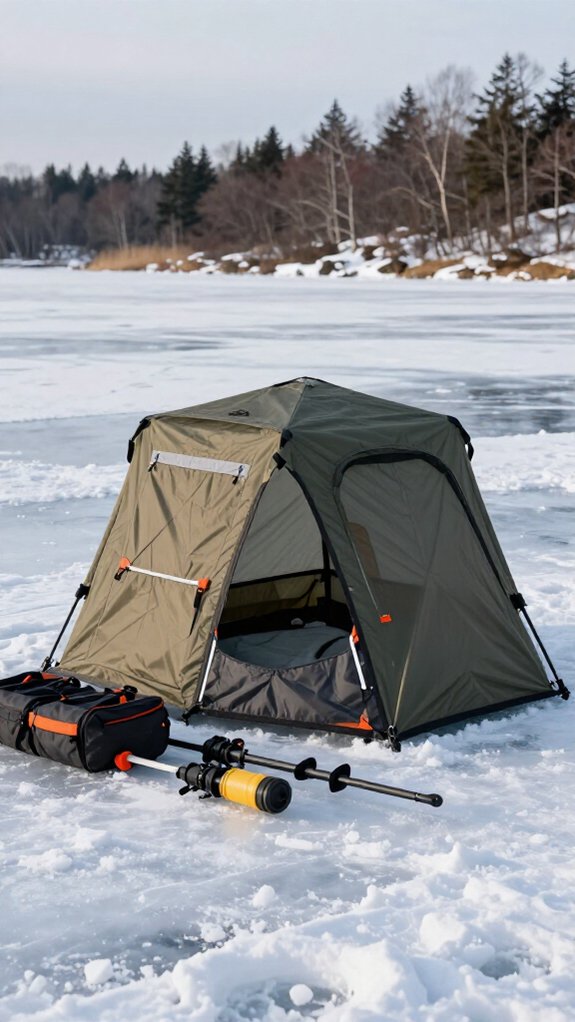
How far are you willing to lug your gear before your arms give out? I always ask myself this before committing to a shelter size.
Your transportation method dictates everything. I’ve crammed bulky shelters into compact cars and regretted it instantly. Match your shelter’s dimensions to your vehicle, ATV, or snowmobile.
Weight matters more than you’d think. I can haul my 35-pound Eskimo Quickfish 3i across slushy parking lots without breaking a sweat. But that 180-pound Clam X-1200? That’s a two-person job requiring a sled.
For foot travel, I swear by compact design options. They pack tight and won’t destroy your back. Before buying, honestly assess your physical capacity. Nothing ruins a fishing trip faster than wrestling impossible weight across half a mile of ice.
Count Fishable Square Feet, Not Total Floor Space
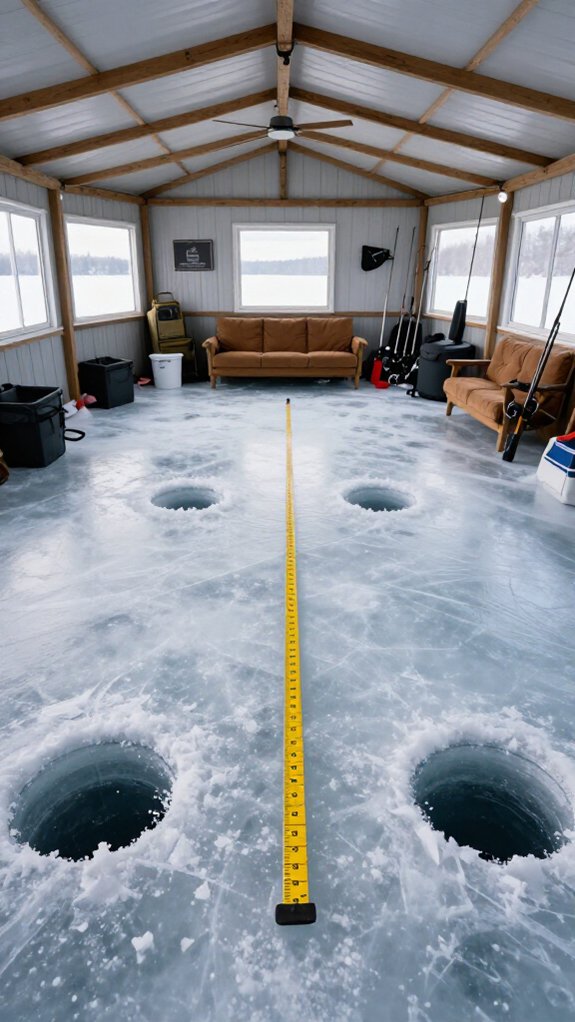
I always measure the real usable space inside a shelter, not just the outer dimensions printed on the box, because that’s where you’ll actually be drilling holes and fighting fish.
You’ll want to account for gear storage zones too, think sleds, buckets, heaters, and extra rods that eat up precious square footage fast.
When I shop for shelters, I look for at least 30-40 square feet of true fishable area for solo trips, or 60-80 square feet if I’m bringing a buddy and our full kit.
Real Usable Space
When I’m shopping for an ice fishing shelter, I’ve learned to ignore the flashy square footage numbers on the box and focus on what actually matters: how much room I’ve got to drill holes, jig, and move around without bumping elbows with my buddy.
I Always measure fishable area, not total floor space. That means subtracting corners where ice chunks pile up and zones where the heater sits.
For comfortable angler capacity, I’ve found these guidelines work:
- 30-40 square feet – Tight but workable for one or two anglers with minimal movement room
- 60+ square feet – Breathing room for three anglers to spread out and jig freely
- 80+ square feet – Sweet spot for extended group trips with actual interior space to spare
- Subtract 10-15% – Rod holders and seat mounts steal real estate you thought you had
I Size up by one capacity level. Four guys means I buy the six-person shelter size. That extra buffer prevents the claustrophobic shuffle when someone’s hooked into a lunker.
Gear Storage Zones
Gear storage zones eat up fishable square footage faster than you’d think, which is why I always map out where my stuff’s going before I commit to a shelter size.
I’ve learned that a smart interior layout separates gear storage from your fishable area. I aim for 20-30 square feet of actual fishing space per person: anything less and you’re tripping over rods and heaters. Strategic equipment organization keeps clutter away from your holes, letting you move freely and set lines without hassle.
Here’s how I balance storage against fishing room:
| Storage Approach | Impact on Fishable Area |
|---|---|
| Wall-mounted rod holders | Preserves floor space |
| Overhead cargo nets | Minimal intrusion |
| Corner heater placement | Maximizes central zone |
| Under-seat compartments | Hidden, efficient use |
| Freestanding tubs | Reduces usable square footage |
Larger shelters offer more fishable area but weigh more. I measure twice, buy once.
Account for Gear, Heaters, and Real-World Elbow Room
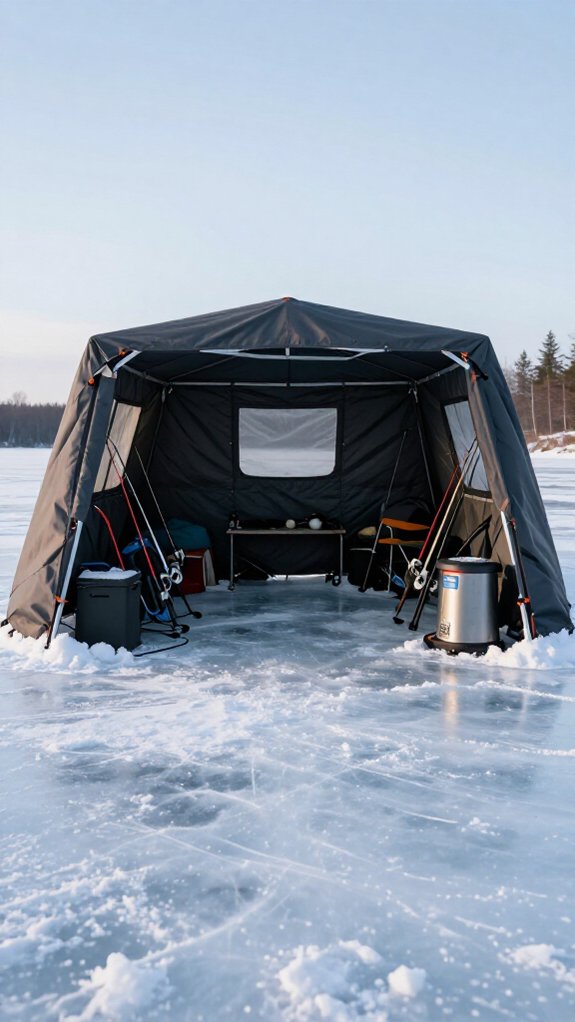
Because I’ve spent too many mornings crammed shoulder-to-shoulder with frozen rods digging into my ribs, I’ve learned that square footage on a box label rarely matches what you’ll actually fish with.
I always size up my interior space by 25-50% beyond my angler count. That extra elbow room isn’t luxury, it’s survival when you’re wrestling with a heater, auger, and three buckets of gear. Heater clearance matters more than you’d think; I’ve seen shelters turn into saunas or iceboxes because there’s no room for safe airflow.
Here’s what I visualize before buying:
- Two anglers trying to stand simultaneously without knocking rods off the wall
- A propane heater glowing red three feet from any fabric or fuel tank
- Tackle boxes stacked like a Jenga tower in the only remaining corner
- Rod bags and coolers forming a maze between you and the door
I customize my setup with adjustable storage and removable seats. For 2-3 people, I won’t go smaller than 8×8 feet. Overnight trips demand 10×10 or larger. Your gear deserves real estate too.
Check Height Clearance Before You Regret It
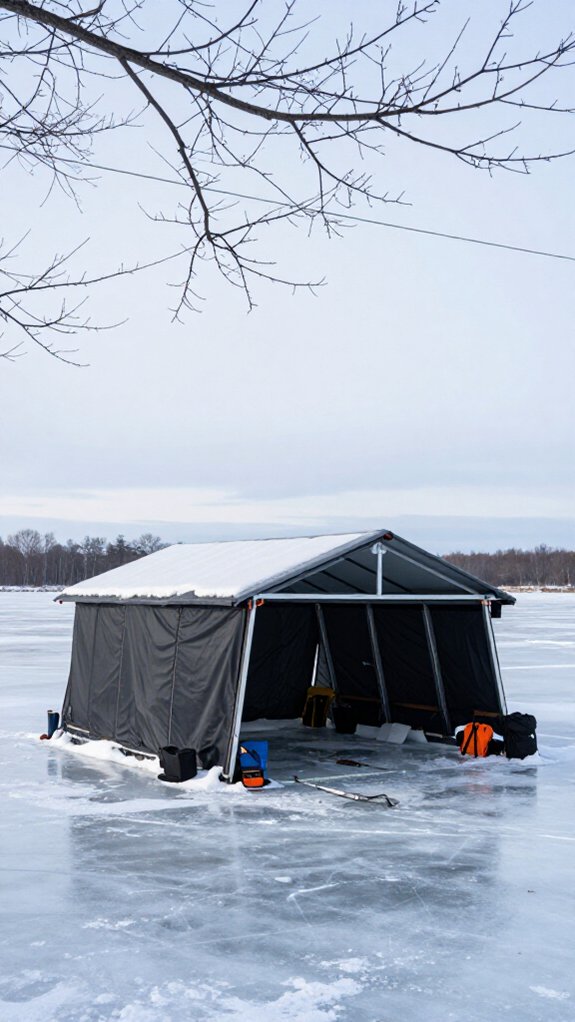
I won’t buy a shelter without confirming I can stand straight inside, because crouching for hours ruins my back and kills the fun.
You need to check three things: true standing room at the center, whether the door forces you to duck on entry, and how sharply the ceiling slopes toward the walls since that eats up usable space fast.
Get these wrong, and you’ll feel every minute of a long day on the ice.
Standing Room Matters
How many hours can you really spend hunched over before your back starts screaming? I’ve learned the hard way that ceiling height isn’t a luxury, it’s survival. For true standing height, I won’t settle for less than 70 inches of interior space. That vertical room changes your portable shelter from a claustrophobic tube into a workable basecamp.
Here’s what proper clearance actually gives you:
- Freedom to stretch stiff shoulders after hauling gear across frozen lakes
- Space to pace when the fish aren’t biting and patience wears thin
- Room to layer up without brushing your hood against condensation
- The simple dignity of not cracking your head on roof supports at 3 a.m.
Taller shelters tip the scales heavier, so I balance that 75+ inch comfort against how far I’m dragging it. Your spine will thank you.
Door Height Counts
Once you’re inside with your gear, the last thing you want is to duck-walk through a doorway that fights you every trip.
I always check door height before committing to any shelter size. For real comfort and mobility, you’ll need at least 80 inches of door clearance, that’s bare minimum for standing upright without cramping your back. If you’re tall or haul bulky equipment, aim for 86 inches or more. I’ve learned to measure my height plus a few extra inches to guarantee easy access every time.
| Shelter Type | Typical Door Height | Best For |
|---|---|---|
| Hub-style | 80-82 inches | Average-height anglers |
| Flip-over | 82-84 inches | Mobility-focused users |
| Cabin-style | 86+ inches | Maximum comfort, tall users |
Don’t skip verifying door clearance in the specs. A low doorway kills your comfort during long sessions and limits how you move. The right door height metamorphoses your shelter from cramped box to functional workspace.
Ceiling Slope Issues
Why does a shelter that looks roomy on paper feel like a coffin once you’re fishing? I’ve learned the hard way that shelter dimensions can deceive you, especially when slope design steals your headroom.
Here’s what cramped interior space actually feels like:
- Your beanie brushes cold fabric with every slight lean forward
- Your shoulders hunch automatically, creating an aching neck by noon
- Your auger handle catches the ceiling when you try to stand and drill
- Your breath fogs the low slope inches from your face, trapping stale air
I always measure peak ceiling height now, not just floor space. That steep angle near the walls? It kills head clearance where you stash gear.
Verify true headroom before buying, or you’ll regret it when the fish are biting and you can’t stand to celebrate.
Quick Reference: Shelter Sizes by Group Size
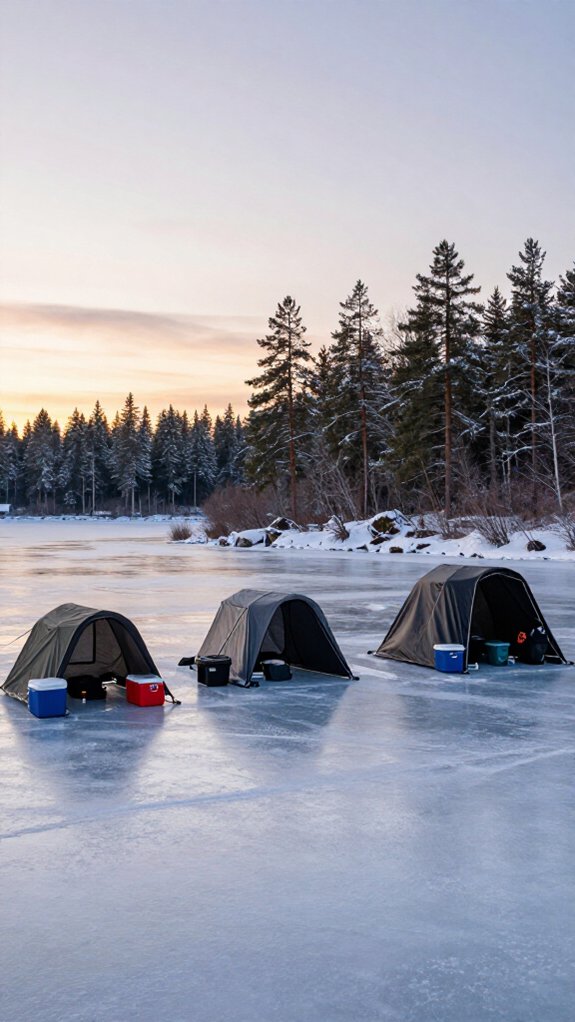
Whether you’re heading out solo or bringing the whole crew, picking the right shelter size can make or break your day on the ice, I’ve learned that cramped quarters turn a relaxing trip into a frustrating shuffle of rods, heaters, and elbow bumps. Here’s how I match shelter sizes to group size for optimal space, gear storage, and comfort.
| Group Size | Shelter Dimensions | Best For |
|---|---|---|
| 1-2 anglers | 4×6 or 5×7 | Portability with room to move |
| 1-2 anglers | 6×6 (36 sq ft) | Extra gear storage and comfort |
| 3-4 anglers | 8×8 (64 sq ft) | Balanced space for group fishing |
| 5+ anglers | 10×10 or 12×12 (100+ sq ft) | Large groups with equipment |
I always add 20% more space than my group needs. This buffer prevents that claustrophobic feeling when heaters, buckets, and tip-ups pile up.
Why Overnight Trips Demand Larger Shelters
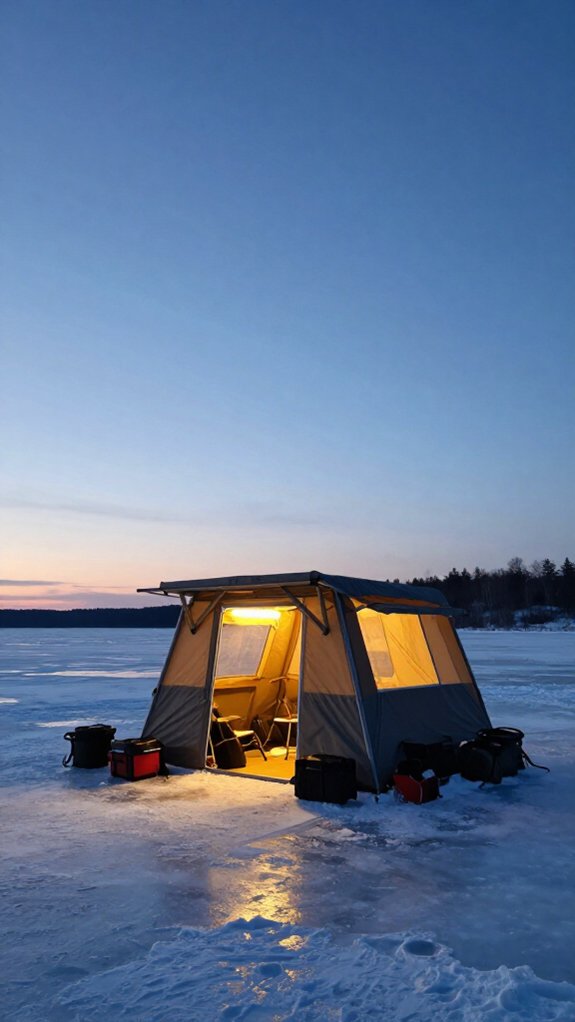
When I’m planning to sleep on the ice, I immediately bump up my shelter size by at least one category from what I’d use for a day trip. There’s simply no way around the extra space I’ll need for a sleeping bag, cot, and the bigger heater that runs all night.
Larger shelters transform overnight trips from cramped survival into genuine comfort during overnight stays. That additional space lets me stretch out, organize gear, and avoid that claustrophobic feeling when darkness settles in for twelve hours.
For extended stays, I’ve learned to prioritize these essentials:
- Room to breathe – space for my cot, duffel, and boots without tripping
- Dual heater zones – keeping one end toasty while I sleep, another for morning coffee
- Insulation options – thicker fabric choices that larger frames accommodate
- Extra storage – stashing coolers, spare rods, and emergency gear inside, not frozen outside
I never regret sizing up.
Verify Your Sizing: In-Store Checks and Return Options
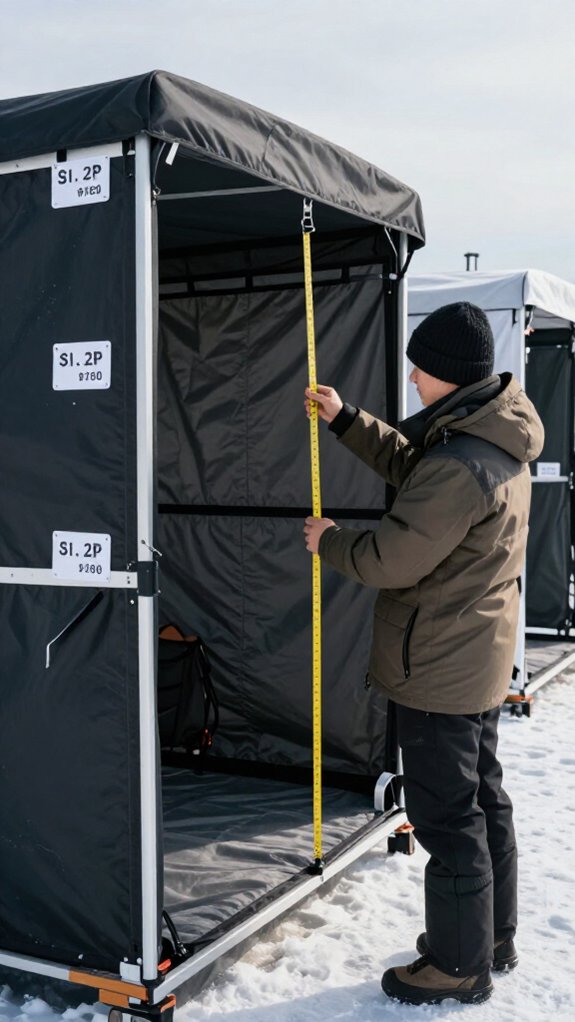
Before I drop serious cash on a shelter, I always verify the fit in person, there’s nothing worse than discovering your new hub-style palace swallows your entire truck bed or, worse, leaves you hunched over like you’re stuck in a crawl space.
I bring my tape measure and bulky gear to check real-world gear accommodation. An in-store setup lets me test assembly speed and confirm shelter dimensions match my fit requirements.
| Check | Why It Matters | My Tip |
|---|---|---|
| Floor space | Ensures room for cots/heaters | Add 2 extra feet for comfort |
| Peak height | Prevents back strain from stooping | Stand fully upright inside |
| Packed size | Confirms transport feasibility | Measure your sled or truck bed |
| Door width | Allows easy gear passage | Test with your largest sled |
I always review the return policy before buying, some retailers accept returns only if the shelter’s unused. Complete your size verification in-store, and you’ll fish warmer and smarter all season.
Frequently Asked Questions
Who Makes the Best Ice Fishing Shelter?
I’d say Eskimo makes the best overall shelter with their Outbreak 450XDP, though Otter excels for tall ceilings, Clam prevails in family-sized options, and Nanook wins for mobile anglers needing quick setup.
What Are the Key Features to Consider When Buying an Ice Fishing Shelter?
I prioritize interior space for anglers and gear, check I’m getting at least 80 inches of headroom, verify there’s enough fishable area for multiple holes, and balance that against how portable and quick to set up the shelter is.
How to Choose an Ice Fishing House?
I hit the nail on the head by matching my shelter to my crew size and fishing style, I’ll add extra space for comfort, check I’ve got 30-40 sq ft per angler, and balance portability with standing room.
What Are the Different Types of Ice Fishing Shelters?
I know two main types: hub shelters and flip-over shelters. Hub shelters pop up quickly and give me lots of space for staying put. Flip-over shelters attach to sleds, so I can move fast and fish anywhere.
In Conclusion
Choosing the right ice fishing shelter means balancing your group size, gear load, and how far you’re willing to haul it across frozen lakes. I’ve learned the hard way that cramped quarters ruin good fishing days, so measure twice and buy once, your future self will thank you when the wind’s howling and everyone’s got room to breathe.
Remember: It’s better to have extra space you don’t use than to need space you don’t have.