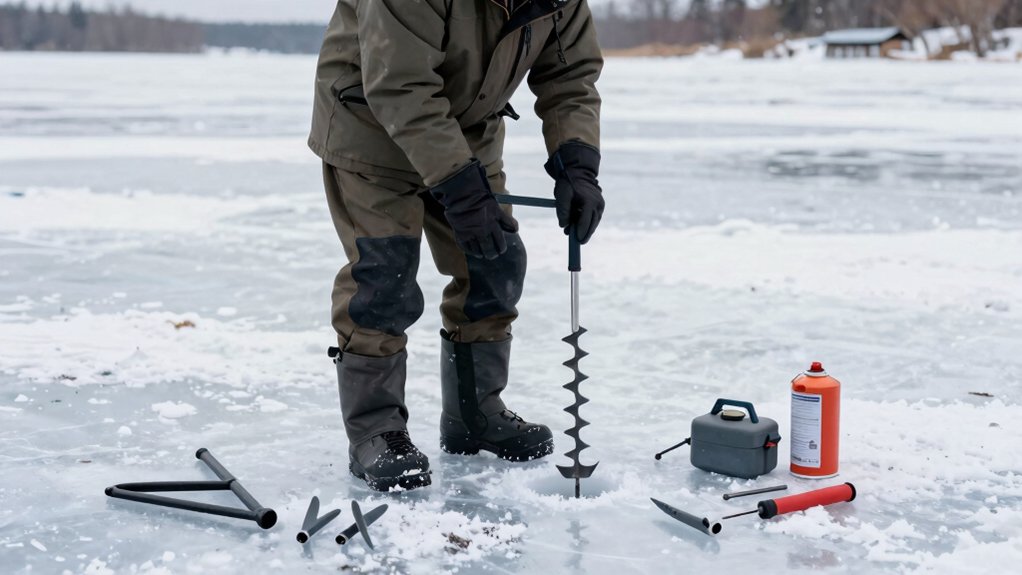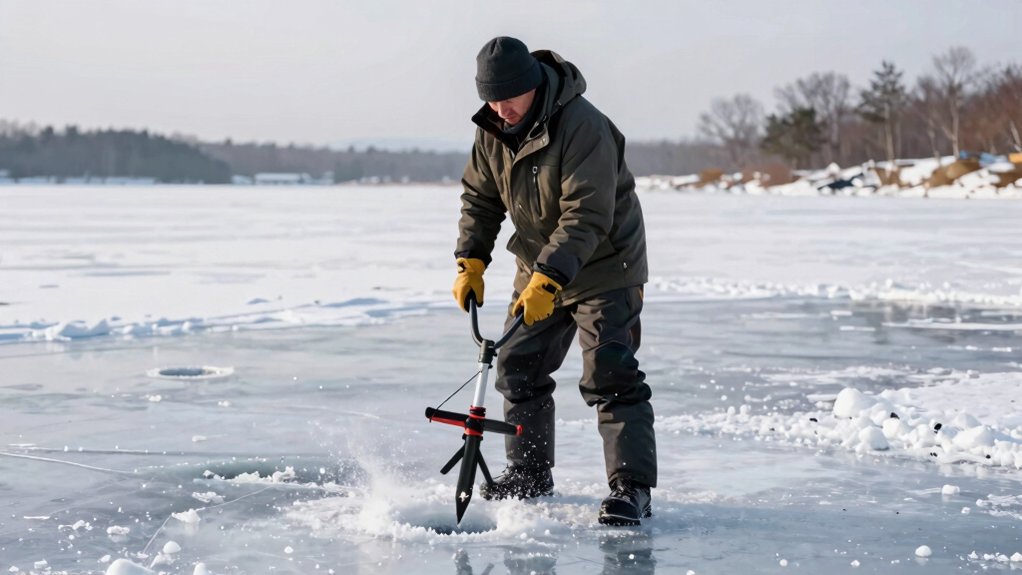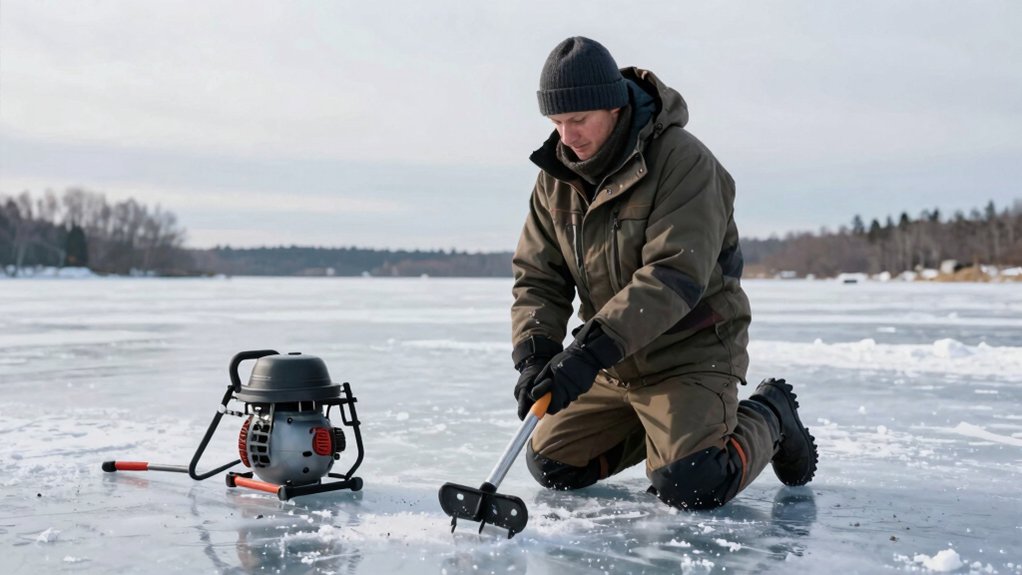
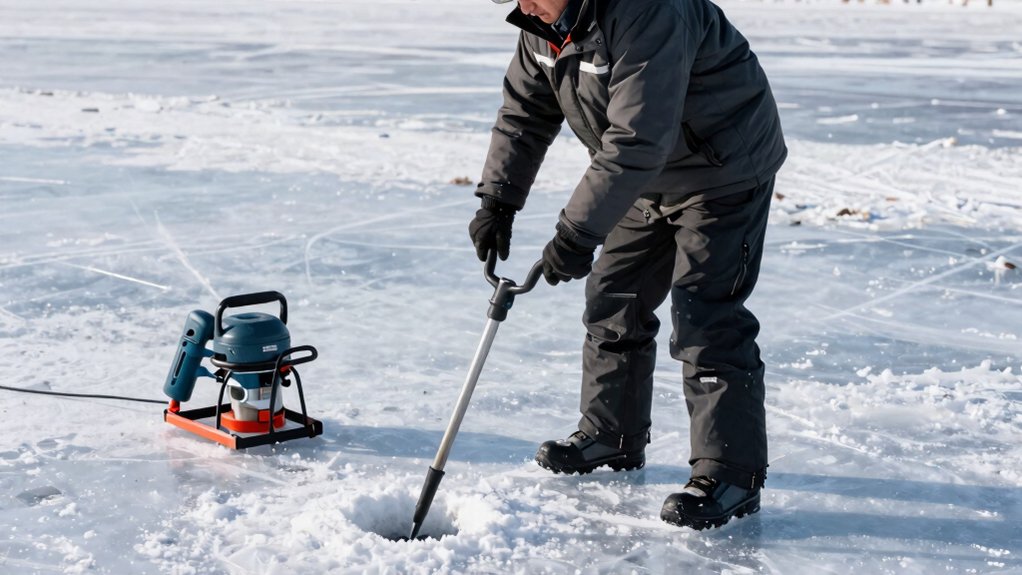

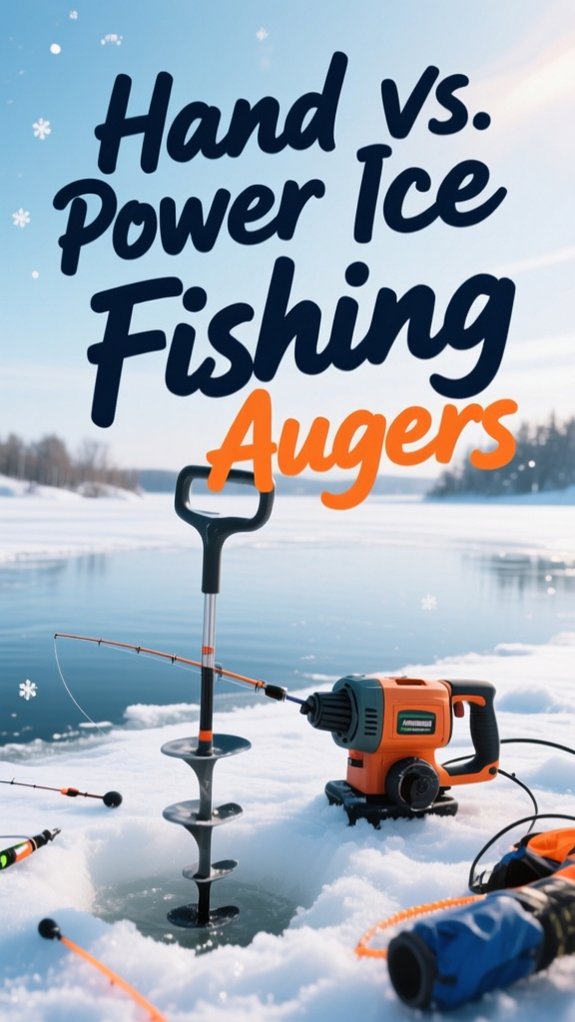
Hand augers win for quiet, lightweight simplicity on early ice under 12 inches, while power augers prevail when you’re punching dozens of holes through thick, hard ice. I’ve found manual models weigh just 6-12 lbs and never fail in brutal cold, but that 60-90 second drill time per hole wears you down fast.
Gas augers blast through 12 inches in 8-12 seconds even below -20°F, though at 28-38 lbs and 95-100 dB they’ll spook finicky fish. Electric augers split the difference at 12-18 seconds and 70-75 dB, but expect 20-30% power loss when temps drop below -10°F. Your best pick depends on how much ice you’re facing, how far you’re walking, and whether stealth or speed matters more that day, and there’s more to unpack on matching auger to actual fishing scenarios.
Hand Auger vs. Power Auger: Which Fits Your Fishing?
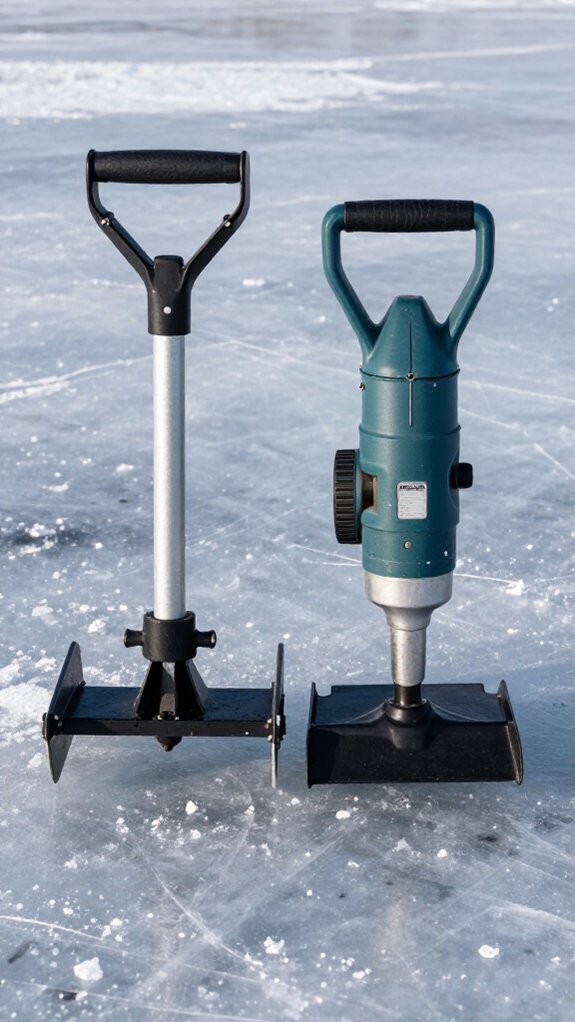
How do you know which auger truly matches your ice fishing style? I’ve learned it comes down to balancing your priorities on the ice.
The Core Trade-Offs
When I’m choosing between manual and power augers, I weigh five factors:
- Physical effort: Manual augers demand real elbow grease, 60-90 seconds of cranking per hole. Power augers spare your arms entirely, letting you punch dozens of holes without fatigue.
- Cost: I’ve spent $80-200 on quality hand augers, while reliable power augers run $300-900+.
- Portability: At 6-12 pounds, manual augers win hands down for mobility. I sling mine over my shoulder and walk anywhere.
- Ice thickness & reliability: For thin early-season ice, manual works fine. When I’m facing two-foot thick late-winter ice, only power augers deliver the ice drilling reliability I need.
- Ease of use: No fuel, batteries, or maintenance with manual, just twist and go.
Drilling Speed: How Fast Each Auger Cuts Through Ice
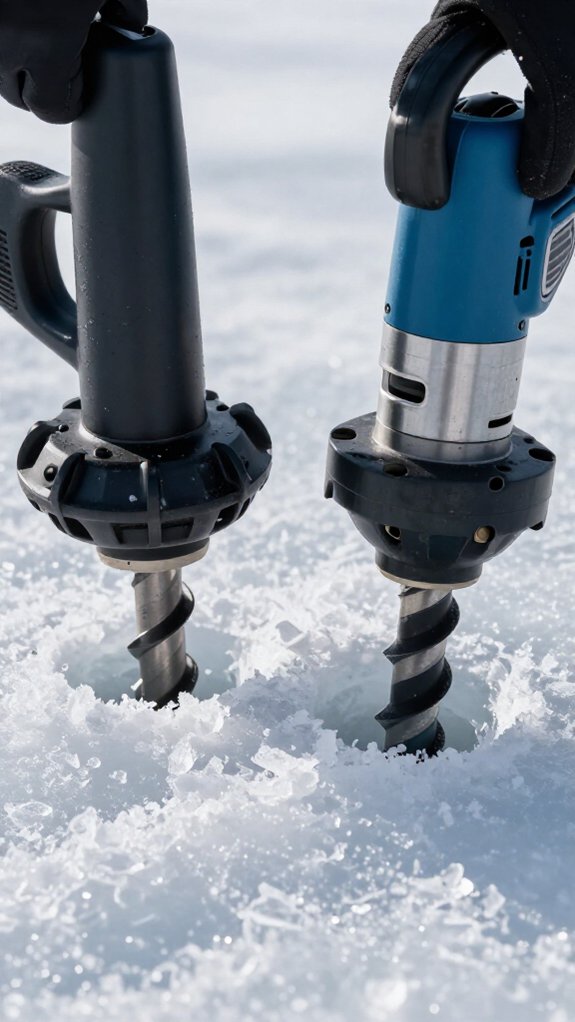
When I’m racing to hit a hot bite before it moves, I don’t want to waste a minute cranking through thick ice. That’s why I always compare hand auger speed against power auger speed before deciding what goes in my sled.
Let me break down exactly how each option performs when you’re punching holes in a hurry.
Hand Auger Speed
Although power augers grab all the headlines for raw speed, I’ve learned that understanding how fast a hand auger actually drills helps you decide whether the trade-off in effort is worth it for your style of fishing.
In my experience, a hand auger typically takes 60-90 seconds to punch through 12 inches of ice, though I’ve seen drilling time stretch past 90 seconds when ice thickness exceeds 16 inches. The manual operation demands real physical effort, and your shoulders and core feel every rotation.
Here’s what shapes hand auger efficiency in real-world ice fishing:
- Blade sharpness dramatically affects speed; dull blades double your drilling time
- Ice thickness directly limits drilling capacity on any given day
- Your stamina determines sustainable hole-cutting numbers
- Weather conditions impact manual auger performance more than you’d expect
Power Auger Speed
Power augers completely change the math on the ice, turning a minute-long chore into something that happens in the blink of an eye. When I’m punching holes across a frozen lake, drilling speed makes all the difference between fishing and waiting.
How Power Changes Everything
My gas-powered ice auger tears through 8-12 inches in 8-12 seconds flat. That’s roughly 4-5 holes per minute when I’m moving fast. My electric auger takes slightly longer, 12-18 seconds for the same ice thickness, but still demolishes any manual auger I’ve used.
Drill Speed by the Numbers
| Power Source | Time for 12″ Hole |
|---|---|
| Gas-powered | 8-12 seconds |
| Electric auger | 12-18 seconds |
| Drill-based (high-torque) | ~6 seconds |
| Manual auger | 60-90 seconds |
Performance drops slightly in brutal cold or when ice thickness exceeds 16 inches, but power options maintain consistent drill speed where hand cranking becomes exhausting.
Weight and Mobility on the Ice
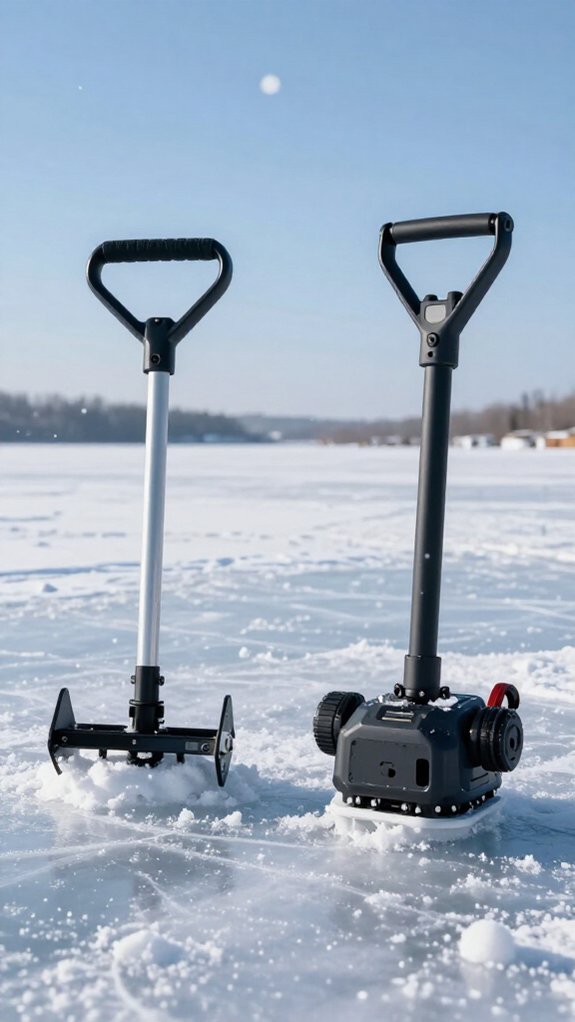
I don’t want to haul a tank across frozen lakes, so weight matters more than most folks realize until they’re post-holing through slush with a dead arm. Your ice fishing gear’s portability directly determines how many holes you’ll punch and how long you’ll stay mobile.
Here’s how weight breaks down across options:
- Manual augers tip scales at just 6-12 lbs, offering unmatched handling and zero fatigue on long treks
- Electric augers land at 17-25 lbs, blending decent maneuverability with less drain than gas models
- Gas augers hit 28-38 lbs, turning every relocation into a workout that kills mobility
Lighter setups mean safer movement. I’ve watched buddies slip lugging heavy rigs, while I scoot across with balanced electric augers. When you’re racing to follow a school, that weight difference decides whether you’re drilling or watching.
Noise Levels and Spooking Fish
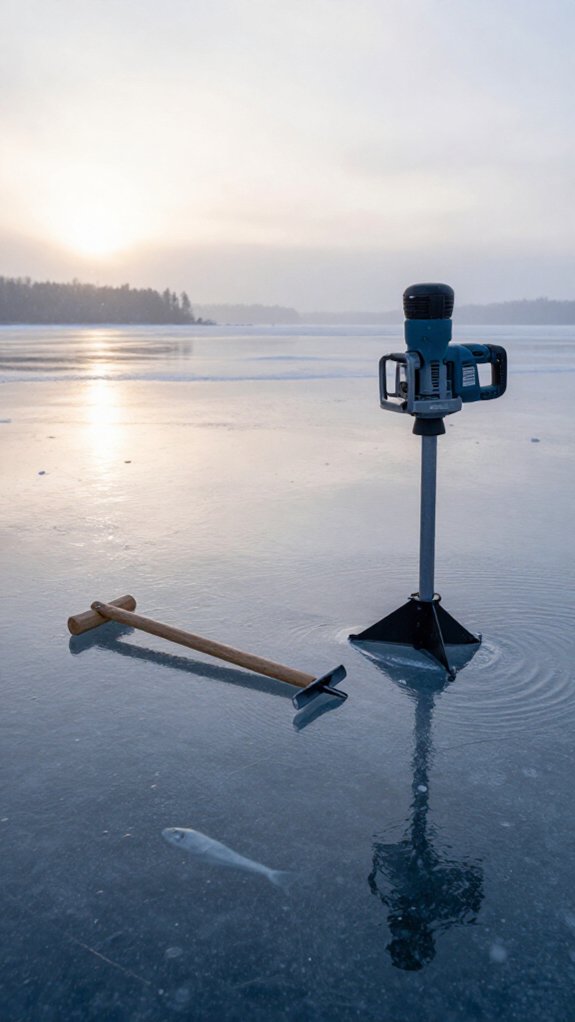
Once you’ve lugged your gear to the spot, the last thing you want is to announce your arrival to every fish within fifty yards. That’s where noise levels become critical.
The Sound of Success
I’ve watched fish behavior change instantly when a gas model fires up. Those power augers blast 95-100 dB through the ice, that’s chainsaw-loud. The fish disturbance is immediate; fish scatter or shut down completely.
Electric augers offer a quieter compromise at 70-75 dB, but they’re still audible below the surface.
The Quiet Advantage
For true quiet operation, nothing beats a hand auger. Its minimal sound output practically eliminates spooking fish.
In pressure fishing scenarios where every edge counts, that silence pays dividends.
When fish get finicky, I’ll trade the sweat for stealth every time.
Cold Weather Reliability and Battery Life
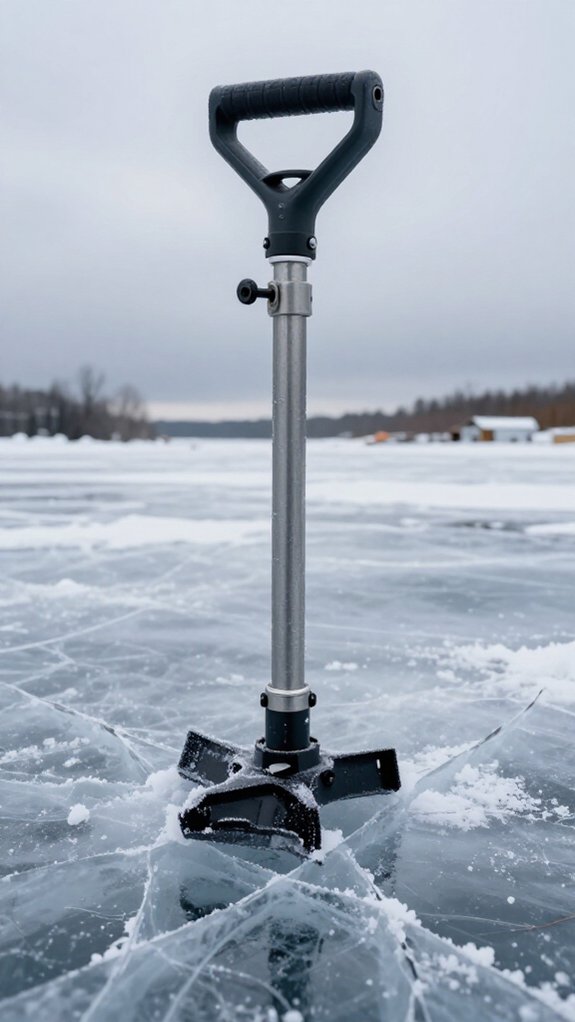
When the mercury drops below -10°F, you’ll watch your electric auger’s lithium-ion battery shed 20-30% of its capacity, turning what should be quick work into a frustrating struggle with sluggish drilling and shortened runtime.
Gas augers sidestep this power drain entirely, though you’ll still need to baby your fuel with stabilizers to prevent gelling.
Manual augers just keep cranking through the coldest mornings without complaint.
I’ll break down how each power source handles bitter cold, because nothing ruins a hardwater trip faster than equipment that quits before you do.
Battery Performance Decline
Why does my electric auger suddenly feel like it’s running on empty when the mercury plummets? I’ve watched my lithium-ion batteries struggle when cold weather hits hard. It’s frustrating when you’re ready to drill and the power just isn’t there.
What Happens to Your Batteries in the Cold
- Chemical reactions inside batteries slow dramatically at low temperatures, cutting power output when you need it most.
- Expect 20-30% capacity loss once readings drop below -10°F, directly shrinking your operational time.
- Without insulation or cold-weather protection, standard battery life plummets just when ice fishing gets good.
I keep spare batteries warm inside my jacket and swap them regularly. Premium packs with built-in cold-weather protection circuitry fight capacity loss better than basic models. A little planning saves your drilling day.
Cold-Weather Engine Reliability
Although I love the quiet convenience of my electric auger, I’ve learned the hard way that not all power sources handle the bitter bite of a January morning equally.
Gas vs. Battery in the Deep Freeze****
Gas engines win on reliability in extreme cold, starting reliably even below -20°F. Their engine durability has been proven through decades of harsh winters. I’ve never had one fail me when I needed it most.
Lithium batteries tell a different story. At temperatures below -10°F, I’ve watched my battery performance drop 20-30%. That’s why I invested in cold-weather protection, insulated compartments that help maintain power when it counts.
Traditional batteries? They’re worse, sometimes freezing solid without warm storage tricks.
And Manual augers? Completely unfazed by low temperatures, boring through ice while I’m fussing with power sources.
Power Source Comparison
I’ve spent enough mornings wrestling with frozen batteries to know that your choice of power source can make or break an ice fishing trip before you even drill your first hole.
Cold-Weather Reliability by Power Source
When temperatures plummet, not all augers perform equally. Gas-powered augers deliver unparalleled cold-weather reliability since they don’t depend on batteries.
Electric augers with lithium batteries face real challenges. I’ve watched my drilling efficiency drop 20-30% below -10°F as those lithium batteries struggle in the bitter cold.
Manual augers remain completely immune to these headaches, making them bulletproof when mercury crashes. But don’t count electric augers out entirely.
- Keep spare batteries inside your jacket for battery warming between holes
- Pre-warm lithium batteries before heading onto the ice
- Choose electric models with built-in cold-weather protection features
- Consider gas-powered augers for extended trips in subzero conditions
Maintenance Requirements and Long-Term Costs
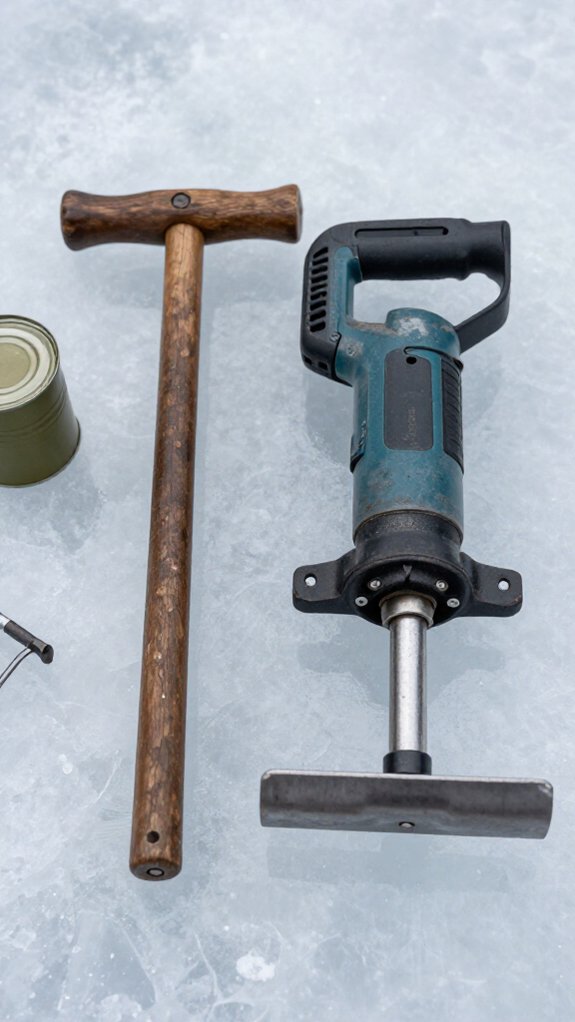
How much is your ice auger really costing you over the seasons? I’ve learned that maintenance differences hit your wallet harder than upfront prices ever do.
Running the Numbers
Manual augers keep things simple, just occasional blade replacement and you’re set. My cost comparison shows 5-year expenses around $110-$320.
Battery care rules electric ownership; store those lithium cells properly and plan on replacement every 2-3 years, pushing long-term costs to $325-$775.
Gas augers demand serious engine maintenance: carburetor tuning, spark plugs, fuel stabilization, which balloons expenses to $650-$1200 with fuel expenses included.
What Reliability Actually Means
Durability isn’t just about surviving harsh winters. Manual units offer unparalleled reliability with zero system checks.
Electric models balance convenience with moderate upkeep.
Gas delivers power but demands constant attention.
For most anglers, I find the sweet spot depends on how much tinkering you’ll actually tolerate between fishing trips.
Best Ice Auger by Use Case: 6 Real-World Scenarios
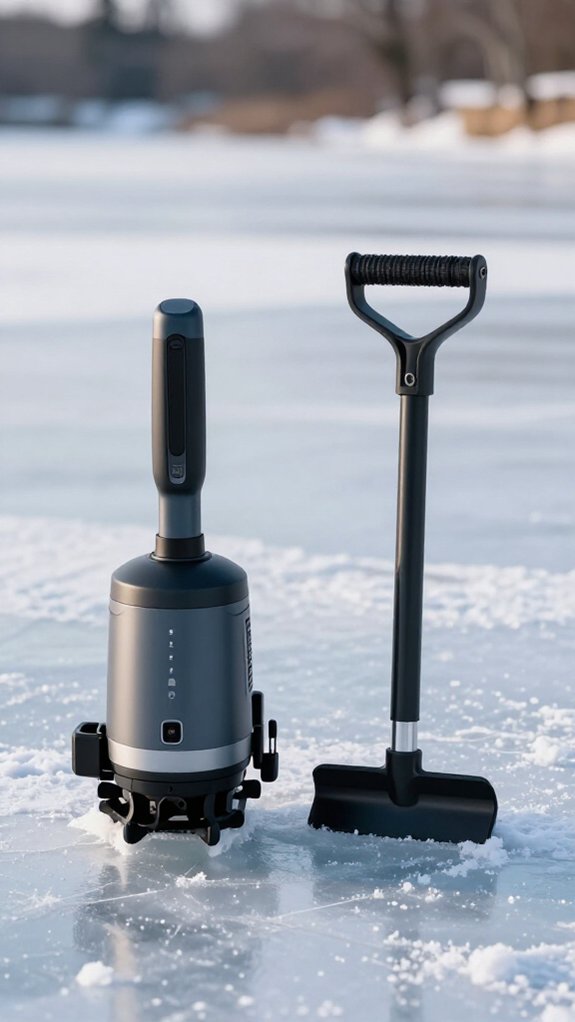
Your maintenance tolerance and long-term budget matter, but they mean nothing if you’re hauling a gas beast onto four inches of early-season ice or struggling with a hand crank when you’re guiding four clients through two feet of hardwater.
I’ve learned that matching your auger to real fishing scenarios transforms your entire ice fishing experience.
Here’s how I break it down by need:
- Solo early-season trips, A manual auger wins on portability and keeps physical effort manageable when ice thickness stays under 12 inches.
- Weekend warriors drilling 30-50 holes, Electric ice auger balance holes per charge with whisper-quiet power delivery through two feet of ice.
- Guiding clients or punching 24+ inches, Gas-powered auger muscle rules brutal conditions without bogging down.
- Run-and-gun sight fishing, Drill-based setups optimize mobility when you’re hole-hopping across the basin.
True Cost Over 5 Years: Gas, Electric, and Hand Auger Breakdown
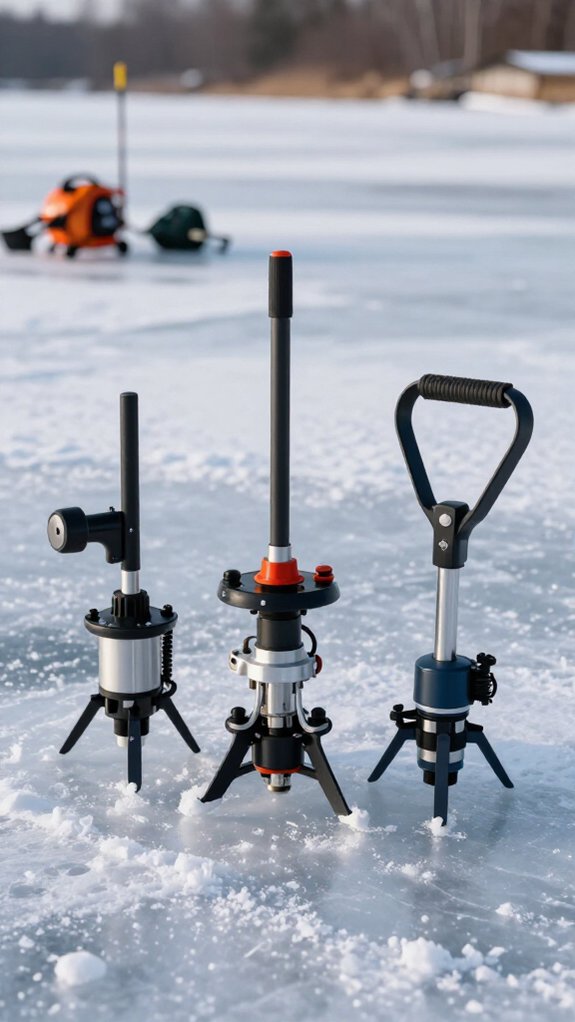
While the upfront price tag on an auger might make your wallet flinch, it’s the long-term tally that’ll either keep you fishing or leave you eating ramen till spring.
The Real 5-Year Damage
I’ve crunched the numbers, and here’s what you’re actually spending:
- Gas augers: $650–$1,200. Fuel, oil changes, and engine maintenance drain your budget fast. The performance is undeniable, but durability suffers if you skip upkeep.
- Electric augers: $325–$775. No fuel, minimal maintenance, just batteries to replace. For casual anglers, this cost wins.
- Manual augers: $110–$320. Blade replacements only. Brutal on the arms, gentle on the wallet.
My Take
If you drill dozens of holes weekly, gas justifies itself. For weekend warriors, electric balances cost and convenience. Manual? Perfect when you’re chasing panfish on early ice and every pound matters.
Your long-term savings depend entirely on how hard you fish.
Frequently Asked Questions
Is a Hand Ice Auger Worth It?
I think a hand ice auger’s worth it if you’re on a budget, fishing thin ice occasionally, and don’t mind the workout. For frequent drilling or thick ice, I’d save my energy and upgrade.
What’s the Best Auger for Ice Fishing?
I choose power augers when I’m drilling through ice over 24 inches thick, since they cut holes in seconds while manual augers take 90 seconds or more. For thin ice and quick trips, I’ll grab my lightweight hand auger instead.
Are Gas Ice Augers Obsolete?
I don’t think gas ice augers are completely obsolete, though they’re losing ground fast. I’d choose electric or manual for most situations now, but I’d still grab gas when I’m drilling through extremely thick ice.
What Are the Different Types of Hand Ice Augers?
I use straight-shaft hand augers for basic drilling, pistol-grip models for better advantage, and folding or telescoping designs when I’m trekking across the ice and need something compact in my sled.
In Conclusion
You need the right auger for how you actually fish, not some fantasy trip. I’ve drilled thousands of holes through the ice, and here’s the honest breakdown: hand augers win for early ice scouting and backcountry hikes where every pound matters, while power augers, gas or electric, dominate when you’re punching dozens of holes to chase roaming walleye.
Consider your drill like a trusty flip phone from 2003: it does one job flawlessly if you pick the right tool for the task. Match your auger to your fishing style, budget, and physical limits, and you’ll spend less time working and more time catching.